


Sotheby’s Just Auctioned off a Prehistoric Predator for $50 Million, Igniting a Debate on Who Actually Owns Ancient History
Ethical dilemma.
Sotheby’s just dropped a prehistoric bombshell. According to The Guardian, the auction house sold a massive Tyrannosaurus rex fossil named Gus for a staggering $50.1 million in New York. The sale shattered records and reignited a fiery debate over who really owns ancient history and whether these scientific treasures should be locked away in private collections.
Gus, a towering 3.8-meter-tall T. rex, now holds the title of the most expensive dinosaur fossil ever sold at auction, blowing past the previous record set earlier this year by a stegosaurus named Apex, which fetched $44.6 million. The skeleton, excavated between 2021 and 2023 on a South Dakota ranch, is one of the largest and most complete T. rex specimens ever found.
With 183 fossilized bone elements and an exceptionally preserved skull, Gus is about 61% complete by bone count and 75 to 80% complete by bone mass. The auction house described it as “an outstanding exhibition-ready mounted skeleton,” complete with a predatory pose that makes it look ready to pounce.
The fossil’s name pays homage to Gary “Gus” Licking
Licking was the landowner who allowed the excavation before his passing. Sotheby’s went all out in hyping the sale, displaying Gus’s massive, detached skull in the lobby of its Breuer building. The auction house didn’t hold back in its description, calling Gus a “monumental item” that required special handling.
Cassandra Hatton, Sotheby’s vice-chairman and global head of science and natural history, celebrated the sale as a testament to the specimen’s exceptional care and preparation. “The market responds when great specimens are taken care of in the right way,” she said.
But not everyone is celebrating
Paleontologists have been sounding the alarm for years about the growing trend of dinosaur fossils being treated like luxury commodities rather than scientific artifacts. Professor Richard Butler, a vertebrate paleontologist at the University of Birmingham, didn’t mince words.
“The current trend towards dinosaur fossils being marketed and sold like rare artworks at vast prices by auction houses is very concerning, as is the idea of buying dinosaur fossils as a status symbol or a commodity,” he said. His concern? Once a fossil like Gus disappears into a private collection, it’s effectively lost to science. “A fossil not in a recognized museum collection cannot be studied and is therefore lost to research,” Butler said.
With prices skyrocketing – Gus sold for more than double its pre-sale estimate of $20 million to $30 million – museums and academic institutions are increasingly priced out of the market. Professor Stephen Brusatte of the University of Edinburgh acknowledged the legality of the sale and its troubling aspect. “As this dinosaur was found in the USA, and in America you can do what you want with what you find on your land, the auction looks to be legal,” he said.
“But as a scientist, it still concerns me.” The problem is simple: when fossils fetch tens of millions, only the ultra-wealthy can afford them. And once they’re in private hands, there’s no guarantee researchers will ever see them again.
This isn’t the first time a high-profile fossil sale has sparked controversy
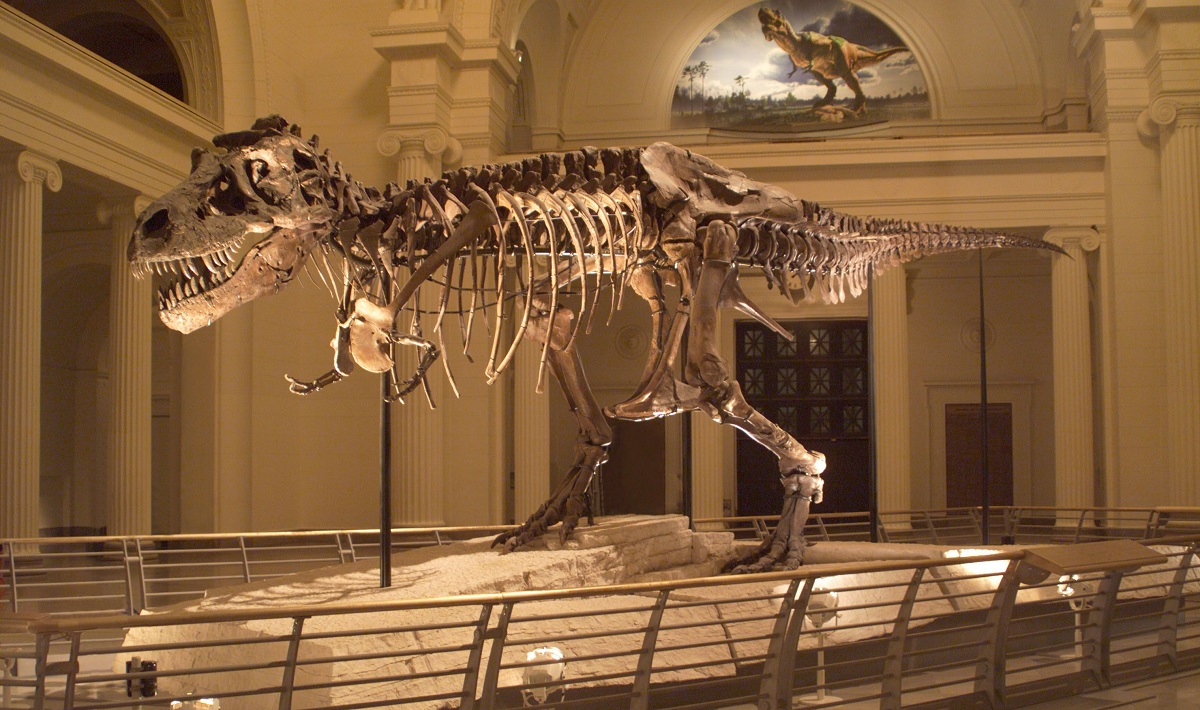
The first T. rex to go under the hammer was Sue, a 4-meter-tall specimen discovered in South Dakota. In 1997, the Field Museum in Chicago acquired Sue for $8 million, thanks to backing from private donors and companies like McDonald’s. At the time, it was a record-breaking sum, but it pales in comparison to today’s prices.
Since then, fossil collecting has become a hobby for the rich and famous, with celebrities like Leonardo DiCaprio jumping into the fray. While some private collectors eventually loan their fossils to museums, experts argue that’s not enough.
Dr. Thomas Carr, a vertebrate paleontologist at Carthage College, said. “A private collection has no guarantee that a fossil will stay in a collection for all time, whereas a public trust’s mission is to maintain, conserve, and curate its collection indefinitely,” he said.
Fossils are both decorative pieces and data. They need to be accessible for scientists to verify old findings and make new discoveries. Many scientific journals now require that fossils used in research be housed in permanent public repositories, precisely because private ownership can’t guarantee long-term access.
Even museum loans come with risks
“The problem is that a privately owned fossil can be recalled from a museum at any moment back into an owner’s home, so the principles of availability and replicability are not guaranteed,” Carr said. Brusatte added, “When we publish research, we need to make sure that research is repeatable, meaning that other scientists can check our data and results and verify our conclusions, or not,” he said.
“The only way for our research to be repeatable is if the dinosaur fossils we study are in a museum, where other scientists are guaranteed access to them.” There’s a glimmer of hope, though. Some private collectors have found ways to balance ownership with public benefit.
The stegosaurus Apex, which held the previous auction record, was purchased by billionaire hedge fund manager Ken Griffin. Griffin loaned Apex to the American Museum of Natural History for four years. It’s a model that could work for Gus. Michael Benton, professor, vertebrate palaeontology, University of Bristol, suggested that private owners might find even more satisfaction in sharing their fossils with the world.
The ideal scenario, according to Carr, would be for fossils like Gus to end up in public trusts where they can be studied and admired by everyone. “A fossil in a public trust is a win for science and society all around,” he said.
(Featured image: Volkan Yuksel)
Have a tip we should know? [email protected]
Follow The Mary Sue:
