


David Harbour Explains What Happened Between Him and Millie Bobby Brown
False allegations?
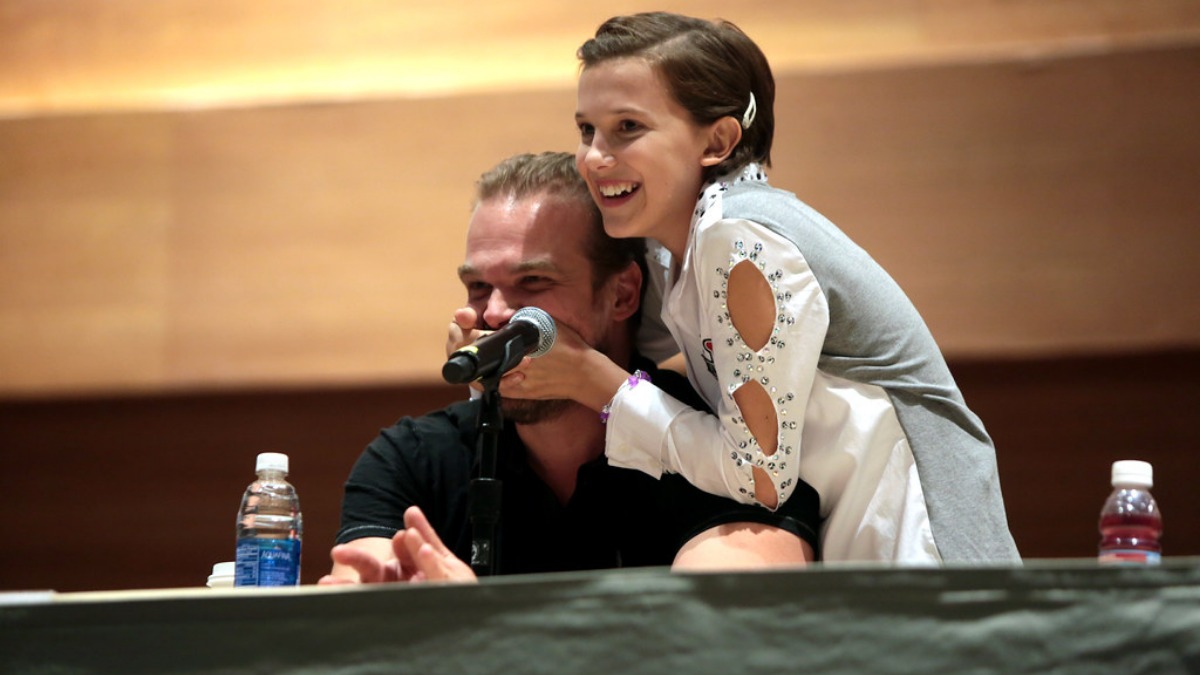
David Harbour just revealed that a false media report about Millie Bobby Brown filing a harassment claim against him triggered a mental health breakdown. The Stranger Things star, who has been open about his bipolar disorder, called the story “weird” and said it contributed to a period of erratic behavior he now regrets.
Harbour told Variety that last year’s tabloid article, which claimed Brown had submitted “pages and pages” of bullying allegations before the final season of Stranger Things, was completely untrue. The timing of the report, coming just a week after his ex-wife Lily Allen released her album West End Girl, which included lyrics criticizing Harbour, only added to the stress.
“I had a breakdown,” he admitted, laughing nervously. “I do suffer from some confusing stuff. It’s confusing as hell.” The actor, who played Eleven’s adoptive father Jim Hopper for five seasons, described his relationship with Brown as one of deep mutual respect. “Millie and I are working on several [projects]… You’ll see more of me and Millie – 10 years wasn’t enough,” he said. “There is a special bond there. I love her. She loves me.”
Brown echoed those sentiments
The actress responded, “Over time, our relationship became much more collaborative creatively. When you work with someone for that many years, we could really push each other emotionally in scenes. Even though the series has ended, there’s still a lot of gratitude. Getting to share that experience with him for so many years is something I’ll always remember and value.”
Harbour didn’t shy away from acknowledging his own struggles, though. He admitted that working on a billion-dollar show like Stranger Things amplified normal workplace tensions. “I don’t know if people have families and friends that you spend a lot of time with for 10 years – you occasionally get in arguments, disagreements,” he said.
“In families, it’s OK because you’re just in a disagreement, and then you come back together. The problem with a billion-dollar show is that there’s just hundreds of people who want to get involved.” He described the situation as a “simple rupture-and-repair thing” that was resolved once he and Brown could talk privately.
The actor has been candid about how his mental health impacts his work
“Under times of extreme stress, that can cause somewhat erratic behavior, and it’s embarrassing, and I’m ashamed of it,” he said. “It’s not something I choose, and I wouldn’t wish it on my worst enemy.” He also reflected on how his sensitivity, something that fuels his performances, can become a liability in high-pressure moments.
“To have a nervous system that reacts to the world in a too-delicate way can allow me to have that moment that I love on the swings with Jason [Bateman in DTF St. Louis],” he said. “But it can also force me, in moments of extreme stress, to act a little weird.”
Harbour’s latest role in DTF St. Louis, an HBO dark comedy where he plays a lovable but troubled ASL interpreter, has been a creative reset after Stranger Things. The show, which follows a murder mystery wrapped in suburban angst, allowed Harbour to explore vulnerability in a way that resonated with his own experiences.
“Floyd just wants to feel loved and as if he has the capacity to share love,” he said. “I want to make things that make people feel safer. My particular talent is in allowing people to feel like they’re not alone.” His process for DTF St. Louis involved physical transformation, including a prosthetic belly and facial hair, to help him embody Floyd’s Midwestern everyman persona.
“It’s a little bit about the landscape of America,” he said, referencing the archetype of the struggling American male. The role also gave him a chance to reconnect with the kind of character work he loved before Stranger Things made him a household name. “I’m not so worried about maintaining an identity in the industry,” he said. “But of course it’s on your mind that you have an opportunity. What’s the coolest thing I could make?”
Harbour’s relationship with fame has been complicated
While he appreciated the perks of stardom, like free ice cream and Knicks tickets, he struggled with the loss of privacy. “After the first six months, the sheen of that recognition starts to wear off a little bit,” he said.
“You actually are just an object to people. You can be an object of joy, or you can be like, ‘I hate that guy.’ And then you’re an object of frustration.” The media frenzy around his personal life, including Allen’s album and the tabloid reports about Brown, only intensified those feelings.
Now, Harbour is focused on moving forward. He recently wrapped Evil Genius, Courteney Cox’s directorial debut, and will return as Santa Claus in Violent Night 2 later this year. He’s also part of the Marvel Cinematic Universe, appearing in Avengers: Doomsday. “We were just pinching ourselves that we get a front-row seat to this process,” he said of witnessing a legendary Marvel moment on set.
Despite the chaos of the past year, Harbour remains committed to his craft. “The challenge, and my hope, is that I just do such a f—ing good job that you, even if you hate me or you love me, you lose yourself in that moment,” he said. “That’s all I really ever want to do.”
(Featured image: Gage Skidmore)
Have a tip we should know? [email protected]
Follow The Mary Sue:
