


Never Before Heard News: Violent Cartoons and Late-Nigh Technology Will Keep Your Preschoolers Up at Night
Assuming Direct Control
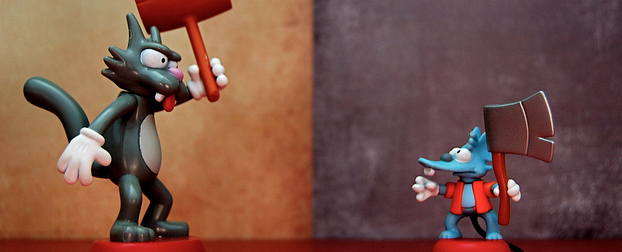

A lot of us have memories of waking up early Saturday mornings and placing ourselves firmly in front of the television, overflowing bowls of Lucky Charms the only physical entities allowed between us and the TV set. It’s practically a hallmark of being a child. A study by the Seattle Children’s Research Institute, however, s saying that (shocker) the violence in some of these cartoons may have a negative effect on some of its younger viewers.
According to the study, young children watching violent entertainment geared towards an audience even just a few years older than then experienced interrupted sleep patterns. More nightmares, “daytime fatigue,” and trouble waking up were experienced by the kids aged 3 to 5 that the study worked with.
These sleep troubles were experienced both after experiencing violent programming and if they were allowed to watch television or go on the computer after 7pm.
So what qualifies as violent programming for children of this age group?
“Bugs Bunny counts as violence in this study, and so does Batman and so does Pokémon,” lead author Michelle Garrison told MedPage Today/ABC News. “Slapstick funny violence in Bugs Bunny or superhero violence in Batman or more realistic violence — we didn’t see a difference in terms of the impact on sleep,”
None of this is particularly surprising; parents and studies alike have been going on about the impact of violence on children for ages and ages. Still, it’s kind of a bummer for the kids–as well as for the parents who have to get their riled-up kids to sleep.
On the study itself:
The finding comes from week-long sleep diaries prepared by parents of 612 three-, four- and five-year-olds as part of a larger research project on sleep and media use. In the sleep diaries, parents reported how often the child had difficulty getting to sleep, woke up repeatedly, had nightmares, had difficulty waking in the morning or was tired in the daytime.
These media diaries found that the children were watching TV or using a computer about 73 minutes a day on average, although some scored more than four hours, Garrison and colleagues reported. That’s less than what some other studies found — reporting averages of two, three or even four hours in the same age group, she said.
A lot of the trouble these kids had in getting to sleep didn’t stem from hours playing overtly violent video games or watching the Saw movies; a lot of it came from watching things that were almost aimed at their age group, but not quite; programming that was made for kids just a couple years older than them.
Even further, it’s focused very much around what the children themselves find frightening; if they’re more afraid of clowns than of axe-wielding coyotes, it’s the former that’s going to affect their sleep. Not necessarily the thing that censors or parents might mark as scary or overly violent.
The study also emphasizes just how much of an effect media use in general can have on young children. Dr. Nusheen Ameenuddin, a pediatrician at the media clinic, said that identifying media use has become a key part of patient care, especially when it comes to academic, behavioral, or weight-oriented issues; “Over the past decade, the evidence linking screen time to sleep problems has become stronger.”
Technology is in many ways a mass opiate; we watch TV to sooth ourselves after long days at work, we stick the kids in front of the TV set or the iPad when they just won’t stop destroying the house. And as someone who spends a large amount of her time in some way connected to technology as part of her job, I have to say that I am very much a fan of the things that it can do.
But it can also be the easy way out, and when it comes to kids especially the growing dependence on media is one that no generation has really seen the long-term effects of yet. It will be interesting to see where it goes.
(via ABC News) (Image via JD Hancock)
Have a tip we should know? [email protected]
Follow The Mary Sue:
