


Will the war on Iran be over soon? Even Trump doesn’t have a firm answer

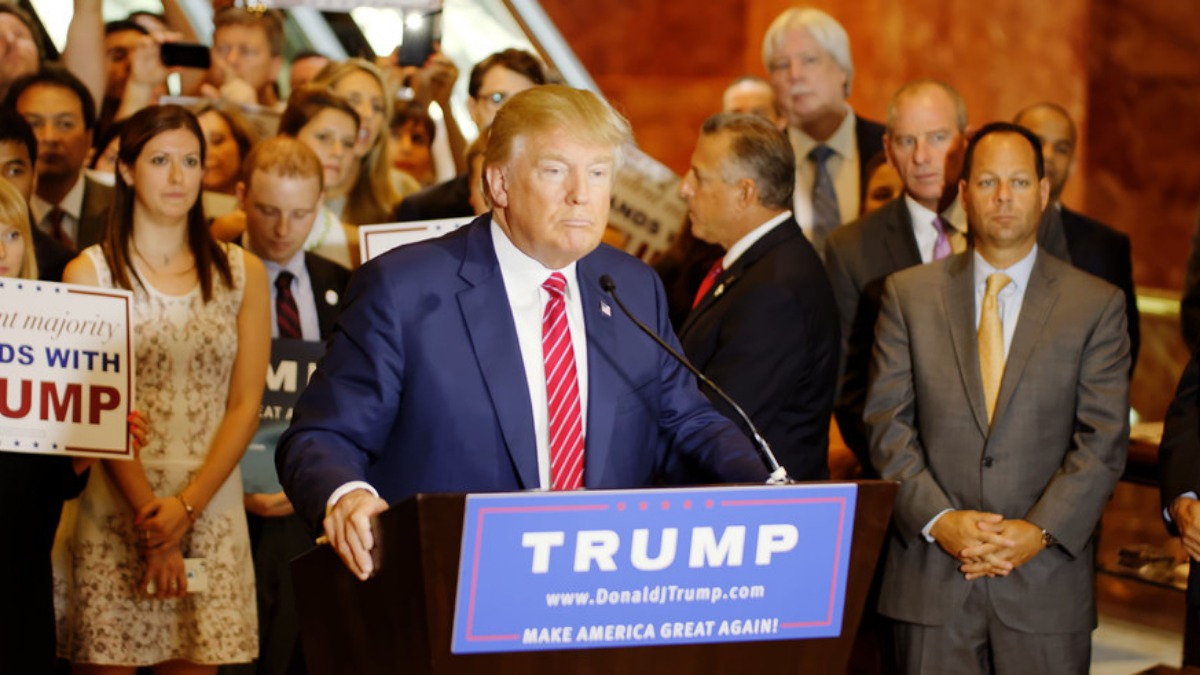
Is the war over? The president needs only to answer yes or no. Instead, reporters have been met with a yes and a no by Trump in a press conference on March 10.
“Mr. President, you said that the war is ‘very complete,’ but your defense secretary says this is just the beginning. So, which is it? And how long should Americans be prepared for this war to last?” This was a question thrown by one of the correspondents at the press conference.
“Well, I think you could say both,” said Trump. “It’s the beginning of building a new country. They have no navy, no airforce. They have no anti-aircraft equipment. It’s all been blown up. They have no radar, they have no telecommunications, and they have no leadership,” Trump says, implying that the war is already won.
“The big risk on that war has been over for three days. We wiped them out in the first two days.” Nevertheless, Trump doesn’t confirm that the operations will cease. Instead, he’s opting to declare an early victory—even if there is a possibility for the war to be long-fought.
According to the press secretary, the war on Iran will only cause a “short-term disruption.” But if Trump is uncertain about the end of the war, what will happen then?
Iran is built to absorb shock
The flaw in the Trump administration’s assumption is that Iran could not sustain a long-term war. According to Iranian Foreign Minister Seyed Abbas Aragchi, “Bombings in our capital have no impact on our ability to conduct war. Decentralized Mosaic Defense enables us to decide when—and how—war will end.”
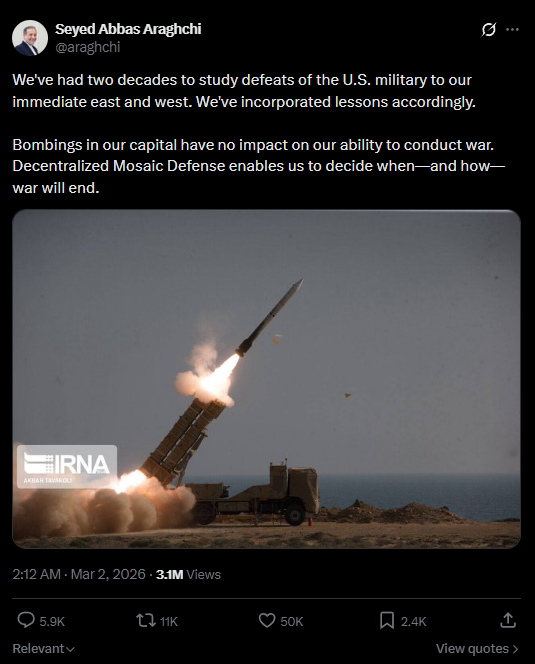
But what is Decentralized Mosaic Defense? As explained by Al Jazeera, it’s an Iranian military concept associated with the Islamic Revolutionary Guard Corps (IRGC). The aim is to decentralize the country’s defense systems into “regional and semi-independent layers.”
This is to say that even if the Ayatollah were a casualty on day one of the war, Iran’s military structure would not collapse overnight. The strategy has been evident in the way Iran was able to fire retaliatory strikes on military bases situated in American-allied Gulf states. Whether this strategy prevails long-term is yet to be seen.
Nuclear weapons as a necessity
Additionally, it’s also been confirmed by the Center for Strategic & International Studies that “Iran still possesses 400 kilograms of 60 percent enriched uranium, and the exact location of that nuclear material remains unknown.” The decentralized nature of Iran’s military makes developments difficult to monitor.
Dr. Rupal Mehta from the Department of Political Science at the University of Nebraska-Lincoln wrote that the United States may have pushed Iran into becoming “a state with a nuclear grievance.” Essentially, Iran no longer sees nuclear weapons as a means to leverage economic sanctions. Rather, nuclear weapons may now be viewed by the Iranian regime as necessities for survival.
If the White House’s strategy is to depose Khamenei and assume that Iran will surrender after sustained fighting, then Trump’s cabinet may be in for a rude awakening. Iran is not Venezuela. Days after Trump struck, Iran had already appointed yet another Khamenei to the position of Supreme Leader. America can declare victory now, but Iran has yet to surrender. In war, the enemy gets a say, too.
(featured image: Michael Vadon, CC)
Have a tip we should know? [email protected]
