


Healthcare Worker Begins Her First Overnight Shift Near an Old Graveyard. Then a Figure in a Flat Cap Appears Behind the Glass: ‘Still Cannot Explain’
Seeking answers.
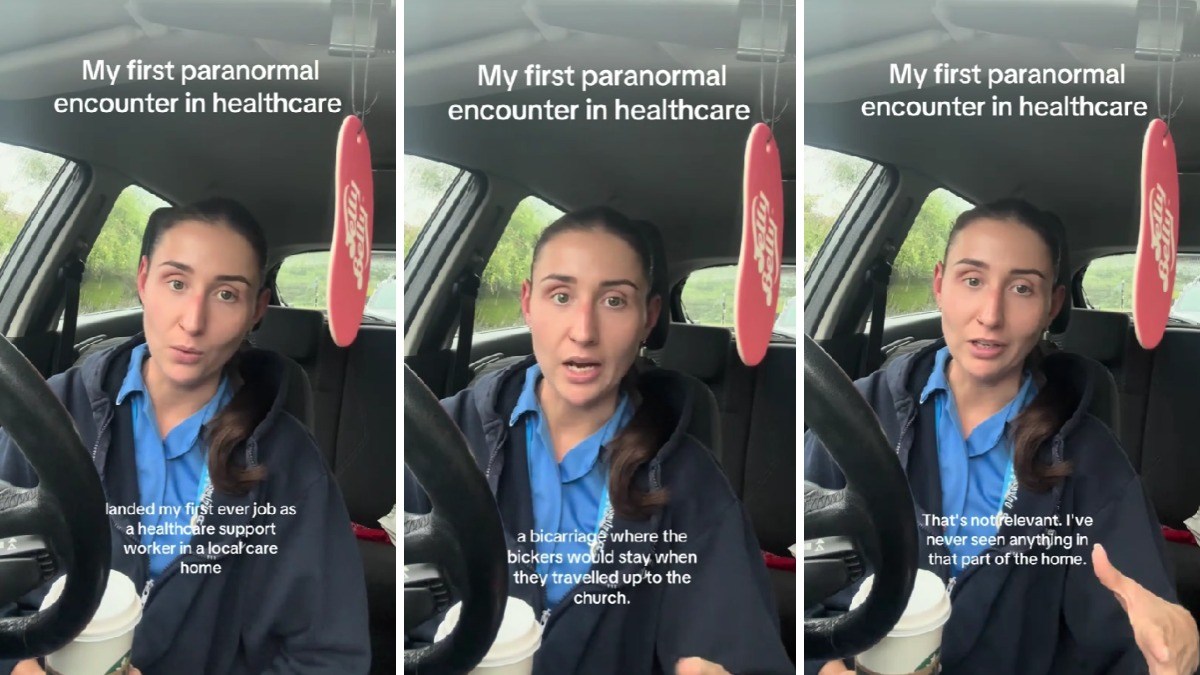
A healthcare worker’s first overnight shift near a graveyard took a turn she still can’t explain. In a now-viral TikTok video, the creator behind @thenursesjournal shared a story that has left viewers both unsettled and fascinated. During her shift at a care home built next to a historic graveyard, she and a coworker saw a figure in a flat cap moving inside a locked office.
The encounter, which happened in the dead of night, has sparked conversations about the eerie side of night shifts in healthcare. The video begins with the worker setting the scene. She had just turned 17 and landed her first job as a healthcare support worker at a local care home. The building had an unusual history – part of it was once an old church, and directly behind it sat a graveyard.
Though she had never seen anything strange near the graveyard itself, the atmosphere was already ripe for something unsettling. A few months into the job, she was scheduled for her first overnight shift, paired with a single coworker to care for about 30 residents.
Around 3 a.m., during their routine two-hour checks, she noticed something odd
At the end of a landing, a large window looked into the manager’s office, a room that was always locked and inaccessible to staff. The office was dark except for the glow of a desktop screen, casting a blue light across the space. As she walked past, she thought she saw movement inside. At first, she dismissed it as fatigue – it was her first night shift, and she was only 17. But when she mentioned it to her coworker, they both pressed their faces against the glass to get a better look.
That’s when they saw him. A figure in a flat cap, moving around the office. The worker described the moment as if the figure turned and looked directly at them. Both she and her coworker jumped back in shock, sticking together for the rest of the shift.
The next morning, they told the day staff about what they had seen. Instead of skepticism, they were met with understanding nods. Some of the long-time employees even shared their own ghost stories, with one colleague bluntly saying, “Why do you think I don’t do night shift here?”
The worker admitted that while she’s heard other strange occurrences in healthcare settings – like call bells ringing with no one there – this was the only time she’s ever seen something she couldn’t explain. Even a decade later, she still thinks about it, wondering who or what it was.
The video has resonated with others in the healthcare community, particularly those who work night shifts
In the comments, nurses and care workers shared their own unexplained experiences. One user, Hannah, recounted a night shift at a nursing home where a bedroom door became mysteriously stuck. When she finally forced it open, the bedside table was blocking the door, drawers and wardrobe doors were open, and the resident – a bed-bound patient – was fast asleep.
Another commenter, Lesley, a registered nurse with over 30 years of experience, wrote, “I could write a book… hospitals are one thing but care homes are on a completely different level!!!!”
Others described taps turning on by themselves, sensor mats going off with no one around, and even seeing patients who had already passed away. One worker recalled seeing a man in navy blue pajamas with white hair walking down a corridor in a hospital with an attached hospice. When she reported it, the nursing staff confirmed that a patient matching that description had died hours earlier.
So why do these stories seem so common in healthcare settings?
Psychologist Melissa Maffeo, author of Science of the Supernatural, offers some scientific explanations for why people might perceive paranormal activity. According to the New York Post, in her research, she identifies three key factors that make ghost sightings more likely: environmental sensations, neurological disruptions, and personality traits.
First, environmental factors like electromagnetic fields (EMFs) and infrasound – low-frequency sound waves humans can’t hear – might play a role. Some studies suggest that high EMF levels can trigger strange sensations, hallucinations, or even time distortions.
Infrasound, meanwhile, has been linked to increased irritability and higher cortisol levels, which could make people more prone to perceiving threats where none exist. Maffeo notes that while there’s a correlation between “haunted” places and fluctuating EMFs, experiments manipulating these fields in lab settings haven’t consistently produced paranormal experiences.
Second, disruptions in the brain’s temporoparietal junction – the region responsible for spatial awareness – can lead to misinterpretations of reality. Sleep paralysis, for example, occurs when the brain’s REM sleep mechanisms linger after waking, leaving a person temporarily paralyzed. Without sensory feedback from their body, the brain fills in the gaps with fear, often manifesting as shadowy figures or presences.
Schizotypy has an impact too
Personality traits like schizotypy – a combination of magical thinking, disorganized behavior, and difficulty distinguishing between self and others – can make some people more likely to believe in and perceive paranormal activity. Maffeo explains that those with high levels of schizotypy often report feeling disconnected from their physical bodies, which might make them more susceptible to sensing ghosts or other unexplained phenomena.
None of this necessarily disproves the healthcare worker’s story or the countless others like it. Instead, it offers a lens through which to understand why these experiences feel so real to those who have them. The isolation of night shifts, the proximity to death, and the eerie atmosphere of older buildings all create the perfect storm for paranormal encounters, or the perception of them.
For those who work in healthcare, these stories aren’t just spooky anecdotes. They’re part of the job. Whether it’s the stress of long hours, the psychological weight of caring for the vulnerable, or something truly unexplained, the line between reality and the supernatural can blur in the dead of night.
(Featured images: @thenursesjournal on TikTok)
Have a tip we should know? [email protected]
Follow The Mary Sue:
