




Donald Trump’s ‘God Squad’ is now tasked with wiping out the last remaining ancient ocean giants
Death of the whale song.

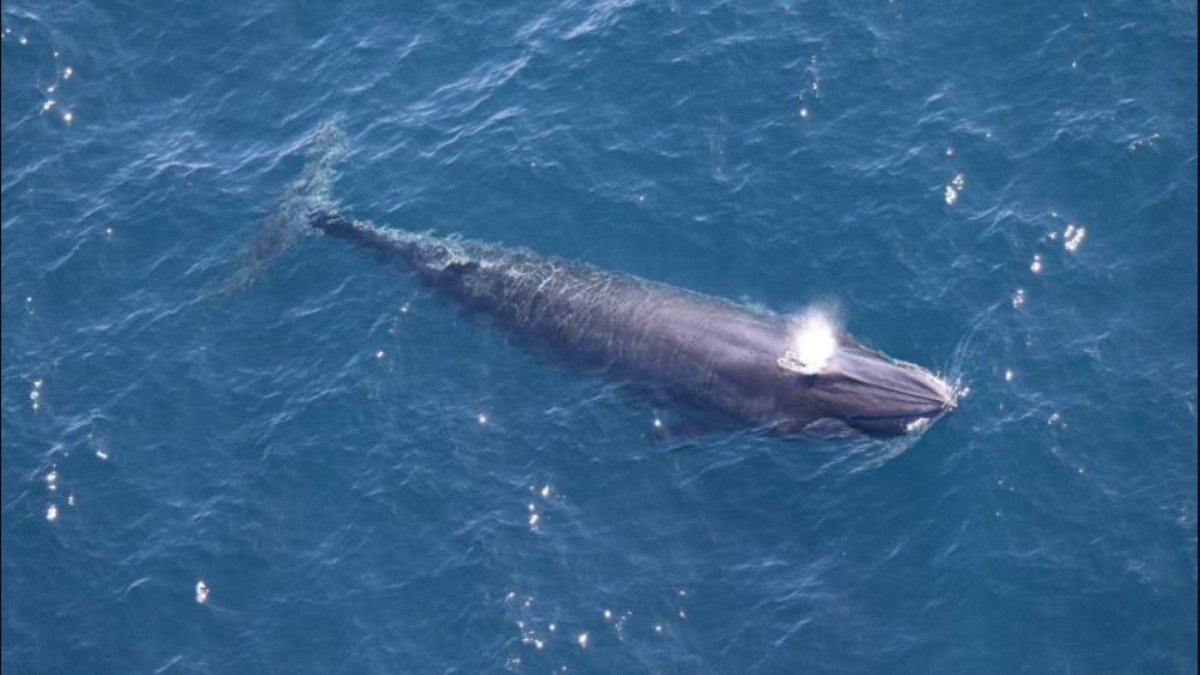
President Donald Trump’s administration recently asked a rare committee known informally as the “God Squad” to scrap all protections for the critically endangered Rice’s whale, along with other marine life in the Gulf of Mexico. This move, made in service of the oil and gas industry, could lead to the first extinction of a whale species in North American waters in three centuries.
Rice’s whales have existed for an incredible three million years, long before modern humans even walked the Earth. According to The Guardian, these leviathan creatures can grow to the length of a bus and weigh as much as six elephants, spending their lives diving deep into the ocean to feast on fat-rich fish.
Their only known home is a specific patch of the Gulf of Mexico, which unfortunately for them, became an area of high interest for oil and gas drilling much later on. Today, there are only about 50 of these baleen whales left.
The ‘God Squad’ can decide whether a species lives or dies
The decision by the “God Squad”, officially known as the Endangered Species Committee, was made last week at a closed-door meeting at the Department of Interior. The entire session lasted barely 15 minutes. Six Trump administration officials agreed to exempt the oil and gas industry from complying with endangered species laws in the Gulf.
This committee holds immense power, essentially deciding whether a species lives or dies, which is precisely how it earned its moniker. This isn’t a common occurrence; the committee has only been convened three times since the process was established in 1978, and not once since 1992.
Usually, a decision by the God Squad follows a rigorous process. An applicant first files a complaint, triggering lengthy reviews. However, in this instance, that extensive process was bypassed. The fate of these imperiled whales, sea turtles, and other at-risk species was put directly into the hands of Pete Hegseth, the Secretary of Defense.
He invoked “national security” as the rationale for the exemption, making this the very first time such a reason has been given since the Endangered Species Act was passed in 1973. Hegseth said that “when development in the gulf is chilled, we are prevented from producing the energy we need as a country.”
He also tied it to current geopolitical events, claiming, “Recent hostile action by the Iranian terror regime highlights yet again why robust domestic oil production is a national security imperative.” Interior Secretary Doug Burgum added that “energy streams in the Gulf of America must not be disrupted or held hostage by ongoing litigation.”
The U.S. is already the world’s leading oil and gas producer
The Endangered Species Act, designed to prevent harassment and harm to threatened species, has never actually stopped a drilling project in the Gulf. Despite this, the national security exemption was pushed through.
This means the Rice’s whale, listed as endangered in the US and critically endangered internationally, will lose the modest safeguards that oil and gas companies were previously required to observe. These included slowing down boats in whale habitats and monitoring for the creatures during exploratory and drilling work.
For Rice’s whales, the only species that spends almost all its time in US waters, all of the major threats come directly from the oil and gas industry. The constant, busy ship traffic in the northern Gulf of Mexico leads to deadly vessel strikes, particularly because these whales often rest at the surface at night. Beyond physical collisions, relentless noise from seismic surveys, pipelines, cables, and drilling operations interfere with their communicative vocalizations.
The 2010 Deepwater Horizon oil spill disaster tragically killed off about a fifth of all known Rice’s whales. Despite this, Andrea Woods, spokesperson, American Petroleum Institute (API), which includes BP – the company responsible for the Deepwater disaster – claimed that “our industry has a long track record of protecting wildlife while developing offshore energy responsibly.”
The Rice’s whale, or Balaenoptera ricei, was only identified as a separate species in 2021. Federal scientists realized it was distinct from the similar Bryde’s whale, differing genetically and in the unique shape of its enormous skull, and it was named after the late cetacean researcher Dale Rice. It has a tiny population, restricted to a small, extremely busy part of the Gulf.
Jeremy Kiszka, biologist and marine mammal expert, Florida International University, said, “There’s a lot of elements that make this species really vulnerable. It is a species living on the edge.” He warned, “The more we’re going to drill, the more we are going to industrialize the gulf, the more likely we are to lose a species that is solely or primarily found in U.S. waters. We can still save these animals, but the situation is dire.”
It’s wild to imagine a whale species being wiped out today
We haven’t seen a cetacean species lost near the North American continent since the North Atlantic population of gray whales was wiped out in the 1700s. In fact, since the 1980s, when commercial whaling largely ceased, worldwide whale populations rebounded strongly.
However, many cetaceans still face significant threats from global heating, marine pollution, and stray fishing gear. Kiszka says Rice’s whales are perhaps the most at-risk species. He noted, “They can’t go anywhere, they don’t have anywhere else.”
Environmental groups have already filed lawsuits to reverse the ruling, calling it illegal. Pat Parenteau, environmental law expert, Vermont Law School, believes “you can’t just wave a national security wand with no process and decide to make something extinct.” He also warned that if the decision is upheld, “we may see national security used to justify anything, from timber sales to new datacenters for AI to more drilling.”
Have a tip we should know? [email protected]
