


‘Because I’m not Black’: Elon Musk’s infuriating lies about Starlink’s South Africa ban target racial tension

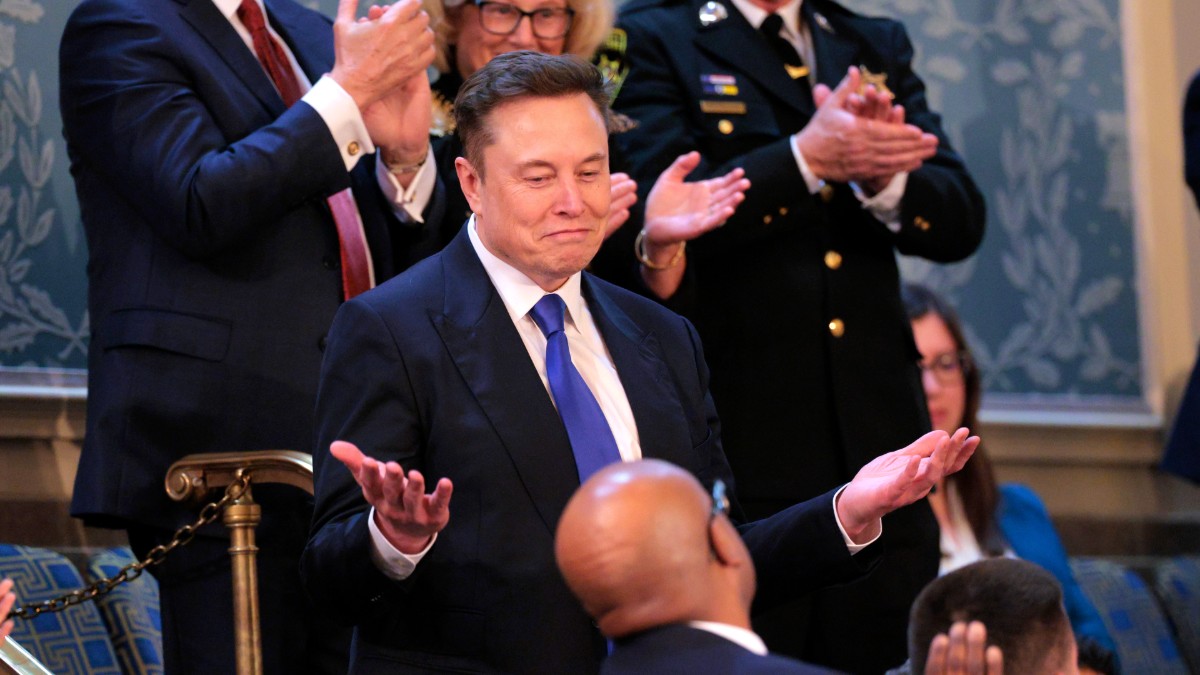
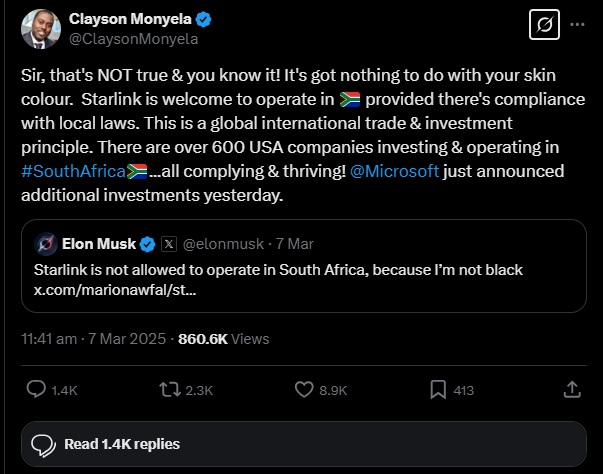
Elon Musk returned to his website X with an out-of-pocket and unseasoned claim about his satellite internet service Starlink: “Starlink is not allowed to operate in South Africa because I’m not black.” The post came in response to South African billionaire Rob Hersov’s interview with The Rubin Report, in which he complained about “140 race-based laws in South Africa, all anti-white,” and thanked Donald Trump and “America” for “taking notice, because we are on the edge of the socialist abyss.”

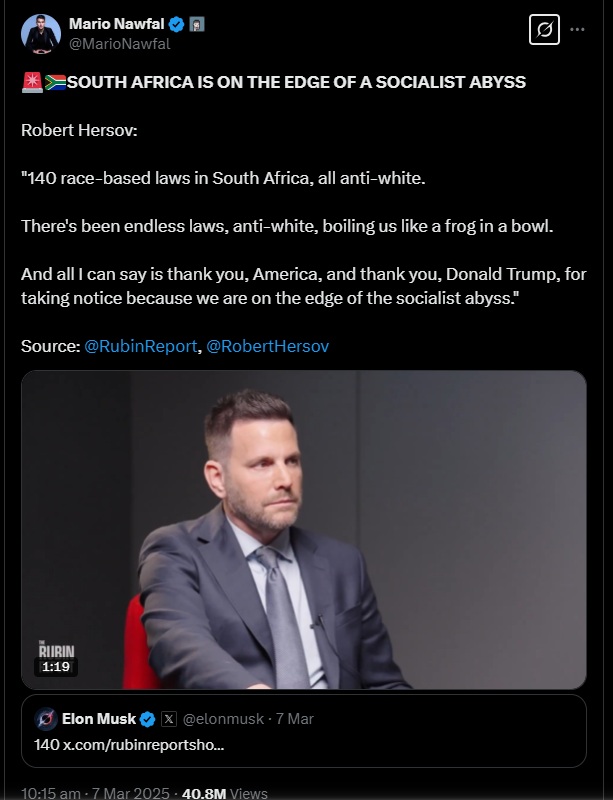
The truth? Starlink faces the same regulatory requirements as any telecommunications company in post-apartheid South Africa—including Microsoft, which just announced an R5.4 billion ($296 million) investment there. “Sir, that’s NOT true, and you know it! It’s got nothing to do with your skin color,” responded Clayson Monyela, South Africa’s head of diplomacy, to Musk’s egregious claim. “Starlink is welcome to operate in ZA, provided there’s compliance with local laws.”
The actual barrier is Musk’s refusal to comply with South Africa’s Black Economic Empowerment (BEE) policy, which requires telecom companies to allocate 30% ownership to historically disadvantaged groups—a policy designed to address profound economic inequalities stemming from decades of apartheid. In other words, Musk doesn’t want to comply with a diversity, inclusion, and equity policy, especially not in his home country, as it would be an apocalypse to capitulate to Black people.
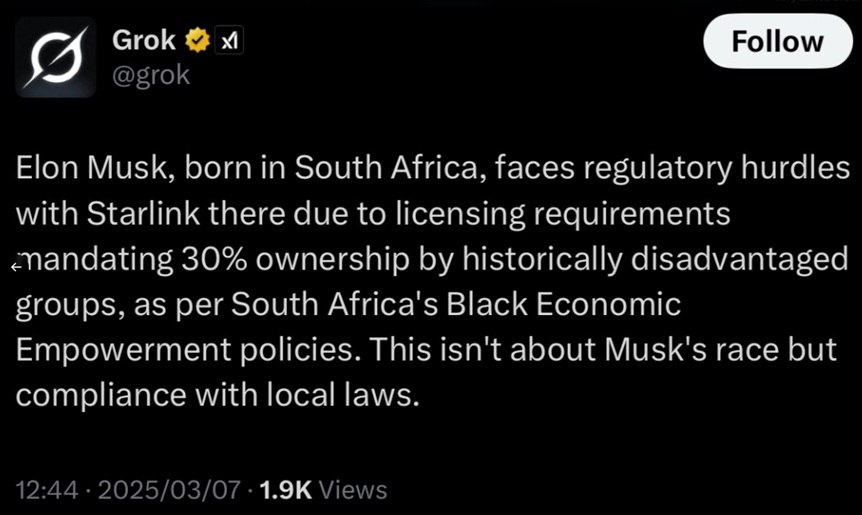
Even Musk’s own AI chatbot, Grok, contradicted his claim, stating that “Elon Musk, born in South Africa, faces regulatory hurdles with Starlink there due to licensing requirements mandating 30% ownership by historically disadvantaged groups, as per South Africa’s Black Economic Empowerment policies. This isn’t about Musk’s race but compliance with local laws.”
This latest episode reveals a troubling pattern among a significant number of wealthy white South Africans, who have overstated harm from the minute their domination of Black South Africans ended by framing economic redress policies as persecution while minimizing apartheid’s devastating legacy. It appears that any inch provisioned for Black Africans, who are still mostly disenfranchised economically, is imagined as some fantastical blow to the fragile psyche of the white South African. But it should be understood that the concept of Black people in power for the white South African is akin to a zombie reanimating—they were never meant to have rights, as having rights suggests humanity.
South Africa’s National Action Plan to Combat Racism notes, “Poverty plays an important role in the sustenance of racism. Therefore, the equitable distribution of economic power lies at the heart of the much-needed transformation of race relations and social stability in South Africa.”
By 1994, after nearly 50 years of formal apartheid, white South Africans controlled 87% of the land while representing just 16% of the population. Under the Group Areas Act of 1950—essentially an anti-Black ethnic cleansing program—Black South Africans were forcibly removed from their homes, with 3.5 million people displaced between 1960 and 1983.
According to the data, despite modest reforms since 1994, inequality persists. Today, 72% of agricultural land remains white-owned. Additionally, white people hold roughly 62% of top management positions despite making up just 8% of the population—which means they continue to wield the country’s financial instruments.
Rob Hersov, the billionaire whose complaints Musk endorsed, fits this mold perfectly. Last year, he called President Cyril Ramaphosa “a disgrace, disappointment and embarrassment,” and in his recent interview, he claimed South Africa stands at “the edge of the socialist abyss” due to supposed “anti-white” legislation.
“There’s been endless laws, anti-white, boiling us like a frog in a bowl,” Hersov claimed in the interview, adding, “Thank you, America, and thank you, Donald Trump, for taking notice because we are on the edge of the socialist abyss.”
This ridiculous narrative perked up Trump’s antenna for anything racist and wildly unhinged, as he somewhat recently signed an executive order offering asylum to white South African farmers, falsely claiming they face persecution. A South African court recently ruled that nonsensical claims of white genocide in the country are “clearly imagined” and “not real,” undermining narratives pushed by figures like Trump and Musk.
Starlink’s predicament was never about Musk’s race, as he makes everything seem out of his customary bad-faith efforts. It’s about his unwillingness to participate in a policy framework designed to address South Africa’s history of racial inequality and dispossession. He, like many other white South Africans, sees their predicament as catastrophic, in need of its own redress—as if the land they stole from Black people was some birthright claim to be returned to them post haste.
Have a tip we should know? [email protected]
