


Donald Trump Claims Preservation Group Exposed Top Military Secrets, but the Real Mystery Is What’s Buried 65 Feet Beneath His New Ballroom
‘These are the TREASONISTS…’
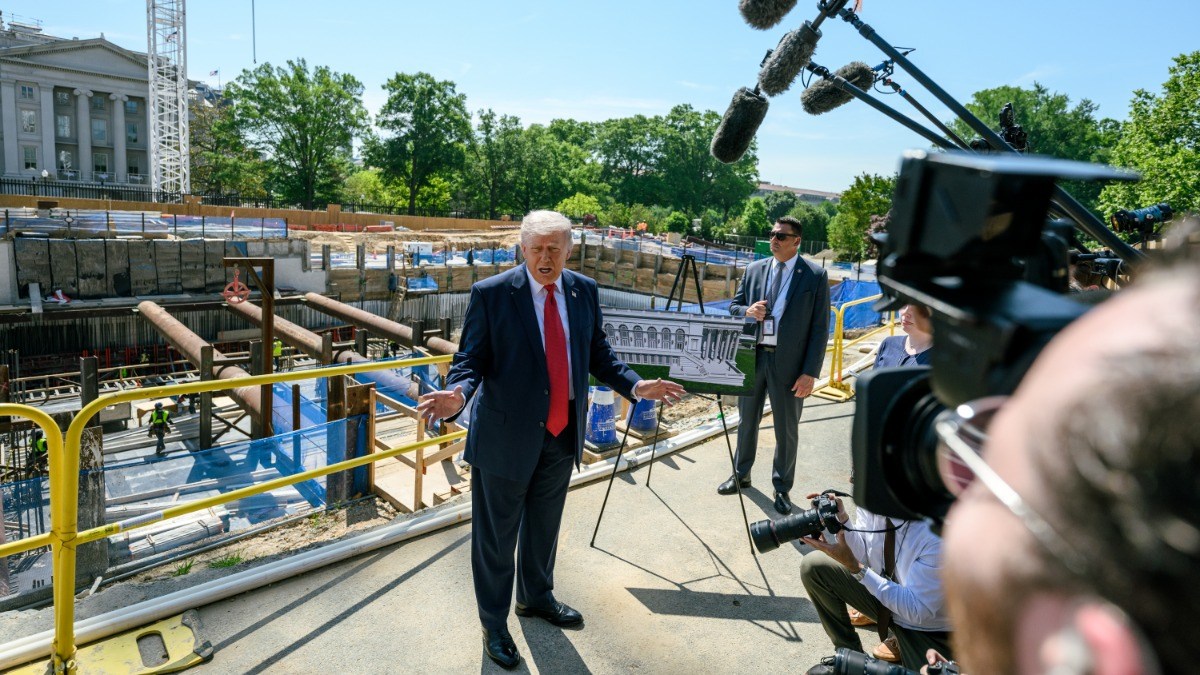
Donald Trump just dropped a bombshell about his new White House ballroom, claiming a historic preservation group exposed “top military secrets” while the real mystery simmers 65 feet underground. According to Newsweek, during a surprise tour of the South Lawn helipad construction on Wednesday, August 19, 2026, the president described a venue where guests could sip cocktails before events.
He also revealed the project includes military-designed bomb shelters and security enhancements buried five stories below the surface. “They get out of the car, and they walk down this path… and they can have cocktails and everything outside of the White House, and then they go into the ballroom,” Trump said. “Even the military, they can use it like that. We have more of… so much of a military component, with the drones and the bomb shelters and everything else that we have in there.”
The president’s comments come as a federal appeals court ordered construction paused by Friday while Congress debates the project’s legality. Trump, however, remains confident the Supreme Court will side with him. “I can’t imagine that the Supreme Court would rule against the ballroom I’m building,” he said, adding, “Hopefully we’ll do very well with the justices.”
National Trust says the administration is trying to “outrun judicial review”
The administration argues that previous presidents made significant White House alterations without congressional approval, framing the ballroom as part of a longstanding tradition. But the National Trust for Historic Preservation, which sued to block the project, calls the move an overreach. Their attorneys argue the administration is trying to “outrun judicial review” rather than seek proper congressional permission.
Trump’s latest accusations against the preservation group take the drama to another level. Over the weekend, he posted on Truth Social that the National Trust revealed “top military secrets,” calling its members “treasonists.” “These are the TREASONISTS that brought the suit against the Military Complex,” he wrote. “They revealed Top Military Secrets!”
The president claimed the group had been shown detailed plans by senior military and Secret Service officials but pursued the lawsuit anyway, despite warnings about the facility’s “Top Secret nature.” So far, Trump hasn’t provided evidence to back up these claims, and the National Trust hasn’t directly addressed the “treasonists” label.
The ballroom is shaping up to be more than just a fancy event space
According to Trump, the underground complex includes a rooftop “DronePort,” bomb shelters, sniper positions, and missile-resistant construction. The administration’s Supreme Court filing describes it as an “integrated military complex” essential for protecting the president and senior officials. But the preservation group’s attorneys argue the project is overkill.
In April, they called the administration’s claim that the lawsuit put Trump’s life at “grave risk” “incorrect and irresponsible.” Gregory Craig, the Trust’s attorney, wrote in a letter to the Department of Justice that the group wasn’t privy to underground details because officials refused to share them beyond public court filings.
The legal battle has been heating up for months. The National Trust filed an emergency request with the Supreme Court on August 18, urging it to suspend the project while the appeals process plays out. Their attorneys argue the administration lacks the authority to demolish a third of the White House and replace it with a 90,000-square-foot ballroom without congressional approval.
“The administration cannot identify any statute granting them ‘express authority’ to destroy a third of the White House and replace it with a massive, privately funded ballroom, because none exists,” they wrote. The Trust’s filing also points out that the preliminary injunction already allows underground military construction to continue, focusing only on halting aboveground work.
The administration sees the project as a national security necessity
According to The Guardian, Solicitor General D. John Sauer, representing the White House, asked the Supreme Court to rule on the stay petition before the appeals court’s decision takes effect on Friday.
“This case involves an extraordinary and unlawful injunction that will halt the ongoing construction of the integrated military complex… at the East Wing of the White House, which is vitally required by national security,” Sauer wrote. The ballroom has been under construction for 10 months, with about 250 workers logging up to 20 hours a day to complete the roughly two-thirds finished project.
What’s buried beneath the ballroom is the real head-scratcher. Trump’s description of a five-story-deep military complex raises questions about how much of the White House’s underground infrastructure is being overhauled. Typically, details about sensitive facilities within the White House complex aren’t publicly disclosed, but the president has been unusually vocal about the project’s security features.
The administration’s Supreme Court filing mentions bomb shelters, drone ports, and missile-resistant construction, framing the ballroom as a dual-purpose venue. If the project moves forward, it could set a precedent for how future White House renovations are handled, especially when national security is part of the pitch.
The preservation group’s legal team is holding its ground
“The preliminary injunction is already narrowly tailored, and limited in scope and duration,” their attorneys wrote. “It expressly allows [the administration] to continue building their underground military facility… and to maintain the safety and security of the White House complex.” The Trust also disputes the administration’s claim that it lacks standing to sue, insisting the project’s scale and impact give them every right to challenge it.
For now, the ballroom remains a construction site, with workers racing to meet deadlines before the court-ordered pause kicks in. If the Supreme Court sides with the administration, the project could resume at full speed. But if the justices uphold the lower court’s ruling, Trump’s vision of a high-security ballroom might face a major setback.
Either way, the debate over what’s happening 65 feet below the White House is far from over. The president’s mix of cocktail-hour charm and military secrecy makes this one of the most unusual White House renovations in history.
(Featured image: The White House)
Have a tip we should know? [email protected]
Follow The Mary Sue:
