



“Just Like Batman:” Geek Art and Our Place in History
Essay
Last week, an acquaintance on Twitter sent me a link to a video by a singer-songwriter named Rebecca Mayes. I have clearly been living under a rock, because it seems that Ms. Mayes has been writing songs about video games for quite a while now. And when I say songs about video games, I mean stuff like this:
I’m not going to lie. I’m a little bit smitten.
What struck me as unique about her work was that this wasn’t the type of tongue-in-cheek geek ballad that typically graces YouTube. Don’t get me wrong, I love that sort of thing. But geek music either tends to come in the form of cheeky parodies of pop songs, or jaunty, witty tunes that get blasted on the drive to Comic-Con (all hail JoCo, peace be upon him). Rebecca Mayes offers something different, something poetic, loving, and downright twee. It doesn’t sound like geek music. It just sounds like…music. Take out the lyrics about Emperor Mengsk and Sims expansion packs, and I might hear this playing at one of my non-geeky friends’ dinner parties.
As I lay on my couch, working my way through her videos, I found myself mulling over a thought that often comes to mind when I encounter really good art inspired by comics or video games. That thought being ancient Greece.
Stick with me here.
I’ve always been a sucker for mythology. I was brought up on museums and PBS, so I suppose it was inevitable. Last Christmas, I was visiting my folks in Los Angeles. One day, my mom and I went to the Getty Villa to see an exhibit on the art of ancient Greek theater. Aside from it being a nostalgic visit to one of the museums of my childhood, Mom wanted me to play informal tour guide (I was a performing arts major back in the day, believe it or not). We strolled around the climate-controlled cases full of cracked pottery and scraps of papyrus as I babbled on about long dead playwrights.
On one particular piece – I can’t remember what it was – there was a description that referred to “Aeschylus’ version” of the story of Oedipus. Mom was curious about this. After all, mythology’s mythology, right? It’s just sort of there. I explained that back in the day, the Greeks held an annual festival in honor of Dionysus, the god of wine and divine madness and other fun things. Every year, the playwrights would compete for the honor of writing the best play. But they weren’t writing original stories, usually. They were writing stories that everybody already knew. They were competing to see who could come up with the best retelling of an old story.
As I said to my mom, “Just like we do with Batman.”
Walk into any historical museum and you will find yourself surrounded by mundane objects. Cups, combs, cheap necklaces. These were not objects that somebody thousands of years ago looked at and thought, “Ah yes, this shall be a priceless work of art one day.” No, these were things that people cooked dinner in and decorated their rooms with and bought from street vendors on a whim, and they are almost universally adorned with characters from their favorite stories. These people lived in homes veritably exploding with images of heroes, villains, monsters, epic battles, and origin stories.
I mean, seriously. What a bunch of geeks.
The “superheroes as modern mythology” argument is hardly a new one. Some classicists get very touchy about this point. If I step back and look at things objectively, I can see where they’re coming from. Set a collectible Star Wars cup from Burger King next to a two-thousand-year-old ceramic bowl lovingly hand-painted with gods and heroes, and there’s no contest as to which object is art. I can see how a devoted classicist might turn up her nose at stories she associates with cheap comics and bad Saturday morning cartoons. How could those dashed-off stories compare with the epics of old?
But they do compare, and very strongly, I feel. The mythologies we hold in such high academic regard had humble beginnings, too. They were told around fires and in rural homes. Occasionally, someone came along and told the story a little bit better, then a lot better, and better still, until the stories were such an intrinsic part of popular entertainment that people decorated their homes and bodies with the characters they knew so well. They wrote songs about them. They clothed themselves as heroes and monsters, and held pageants in their honor. The stories became so deeply ingrained in their culture that millennia later, those same stories give us insights into the way they thought and the things they believed in.
Just like Batman. And all the rest of our heroes.
What I find intriguing about the modern contributions to story-inspired art is that it is one of the few areas in geek culture in which women have a solid place at the helm. Fan artists tend to have a fairly even split between the sexes, but folks who make jewelry and costumes and home decor notably have women in the majority. Now, that is not to say that crafting is a woman’s activity. There are plenty among us who can’t tell crochet from decoupage. Likewise, there are plenty of men who can bust out cross-stitch or cupcakes with the best of them. But the fact remains that, gender-biased as it may be, these activities have traditionally have been delegated to the girls. Demographically speaking, there are more women who know how to sew and collage and hot glue than men. Those who have these skills are moving on from humble tea cozies and painted teacups. The stories we love have taken on a life of their own, and in response, we are doing what cultures have done for thousands of years. We’re making art.
And good art, too. Geeks are often depicted as living in sticky dens of plastic swag and children’s toys (not that there’s anything wrong with that). There are countless sitcoms that have the loveable loser sidekick who wears comic book t-shirts and refuses to throw away his action figures. But geek art is evolving beyond brightly-colored kitsch. It’s hard to go a week without seeing the latest jaw-droppingly intricate pop culture homage appear on Craft or Boing Boing or Instructables (and if you prefer books, there’s World of Geekcraft). We hang framed artwork in our homes (a former housemate had a huge print of Martin Ansin’s A Wretched Hive proudly displayed in our living room; I’m awaiting enough expendable income to order a copy of Andrea Wicklund’s Chell). We have sculptures and carvings and clothing. We have Rebecca Mayes singing about spaceships.
Tell me, what’s the difference, aside from age and materials, between a pendant painted with ancient Greek heroes and any of the dozens of geek-inspired necklaces you can find on Etsy? What’s the difference between the costumed storytelling you can find in virtually every global culture and the cosplayers who become the heroes they love best? What’s the difference between an ornately sculpted Greek mask of a Gorgon and Holly Conrad’s painstakingly detailed mask of a Krogan?
My point is this: after a couple decades of trying to get it across that geek women simply exist, we may actually be at the forefront of ensuring that the mythology of our era is remembered, solely because more of us tend to make things.
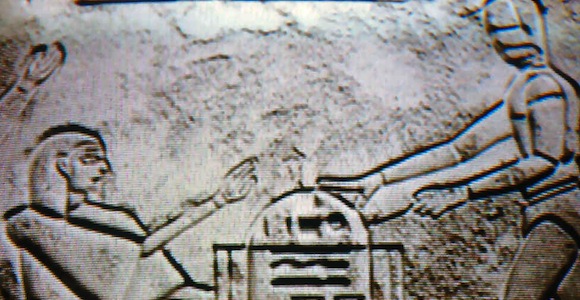
I recognize that I may be waxing a bit hyperbolic. But I imagine a day a thousand years from now, within a climate-controlled museum visited by mutants and the genetically enhanced. The visitors stroll quietly around the cases. Bored-looking androids standing by the doors remind them not to touch or take pictures with their ocular implants. They read the tags marking the ancient fragments of cloth and canvas and sculpted latex.
“Child’s toy, circa 2009 C.E.. Synthetic textiles. Though the details have faded over time, experts believe this to be a representation of the Friend Box from the esoteric Portal saga.”
“Woman’s earrings, date unknown. Mixed media. A rare find given the delicate nature of this work, these simple pieces of jewelry depict the mythical Light Swords of the Jedi Knights. Faded pigments suggest that one sword was colored red, the other green. These colors are symbolic of good and evil, as well as father and son. Their pairing indicates a sense of balance.”
“Cloak clasp, circa 2005 C.E.. Metallic alloy. The meaning of this delicate leaf pattern was a mystery to classicists until 3152 C.E., when a team from the University of Alphonsus Crater stunned the archaeological world with the unearthing of a colossal storytelling workshop in New Zealand. We now know the leaf to be emblematic of the heroes in the Hobbit and Ring stories. This clasp was not found at the workshop; rather, experts believe that it was created by a hobbyist, perhaps as a gift for a friend.”
So, go forth, crafters. Create your fanart and costumes and amigurumi with pride. You’re making history.
Becky Chambers is a freelance writer and a full-time geek. She blogs over at Other Scribbles.
Have a tip we should know? [email protected]