


Trump subtly throws Pete Hegseth under the bus over Iran — why take responsibility when you can deflect?

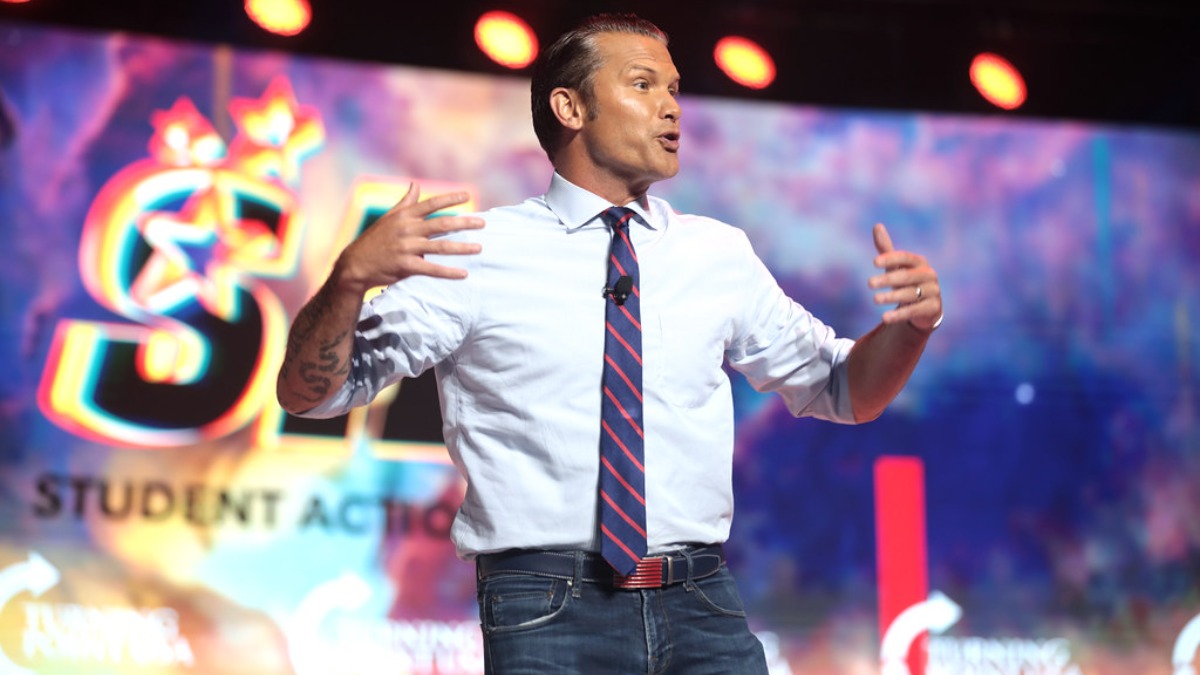
In a press conference, President Donald Trump casually accused Secretary of Defense Pete Hegseth of suggesting going to war with Iran. Although the Trump administration is still moving forward with the campaign, the offhand remark seems to be a setup to pin responsibility on Hegseth.
“I called Pete, I called General Caine,” Trump said. He claimed that he called several people to consult regarding Iran.
“We got a problem in the Middle East. We have a country known as Iran. For 47 years, it’s just been a purveyor of terror, and they’re close to having a nuclear weapon.” This is a disputed claim from Trump, as even the intelligence communities in his administration could not point to the imminent nuclear threat posed by Iran.
The president explained the situation, in which Iran would either keep stockpiling or he could choose to militarily intervene. But then, he proceeded to say that Hegseth was responsible for suggesting Operation Epic Fury.
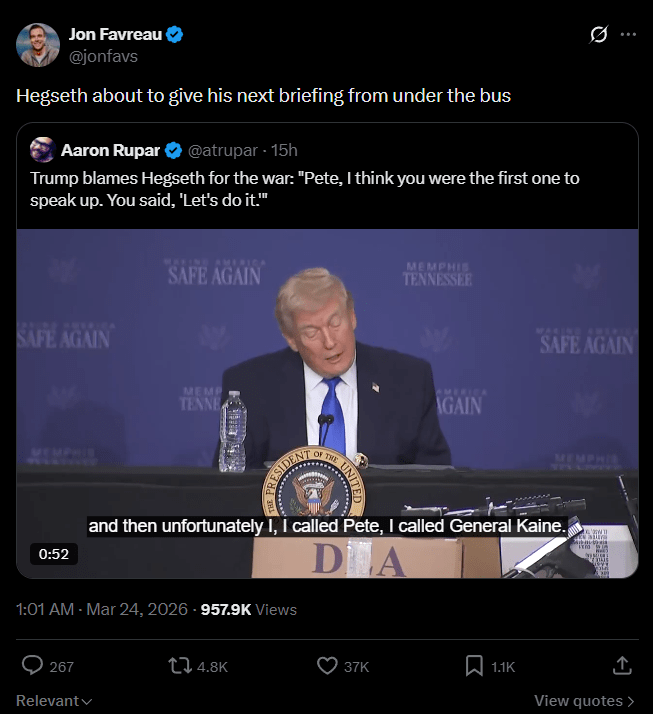
“Pete, I think you were the first to speak up, and you said, ‘Let’s do it,’ because you can’t let them have a nuclear weapon.” To this, Hegseth nodded. While this confirmation might backfire when the situation turns dire for the United States, the Trump administration still believes in the necessity of its campaign.
Jon Favreau of Pod Save America reacted, “Hegseth about to give his next briefing from under the bus.”
Regardless of Trump’s blame-shifting, Hegseth is his appointee. He considered the suggestion and followed through with it. It’s a command responsibility. Therefore, if the United States fails to meet its objectives in the Middle East and destabilizes the global energy market, then the blame is not solely on Hegseth. Trump, not his defense secretary, bears more responsibility for agreeing to the war.
A strongman or a weak leader?
Several MAGA-aligned media commentators condemned the war. Podcast host Megyn Kelly, who lashed out at Sen. Lindsey Graham’s increased involvement in the war, still has faith in Trump. She blamed the neoconservatives that goaded Trump into war but not the man himself, who is in charge.
Although it is a collective choice to go into war, Trump has the authority to dismiss the suggestion. Trump can’t project the image of a strongman while being defended as a leader who was manipulated into the war. Either Trump is to blame for choosing to go to war himself, or he is a weak leader who was swayed into war. These two paradigms can’t coexist.
The situation is dire, with fuel prices mounting. Moreover, the Trump administration is forced to lift sanctions on oil imports from Iran and Russia. The irony couldn’t be understated, as the very countries the United States is fighting would be receiving profit from the temporary easing of sanctions. Now, the war has escalated to the extent of the United States threatening to bomb a power plant in Tehran—significant civilian infrastructure.
In this tit-for-tat, Iran has also threatened to bomb desalination plants in the Middle East. With the lack of rivers and lakes in the Middle East, bombing desalination plants can catalyze a humanitarian disaster in the Middle East. The bottomline is, the war is not de-escalating. Trump also appears to be scrambling for an advantage over Iran.
Should the worst happen, blaming Hegseth alone would be unjust. It’s Trump and his handpicked cabinet who should all shoulder the blame without exemption.
Have a tip we should know? [email protected]
