


Files reveal that Epstein’s private island ‘mosque’ was a grotesque vanity project stocked with stolen holy relics
Sacrilegious ambitions.
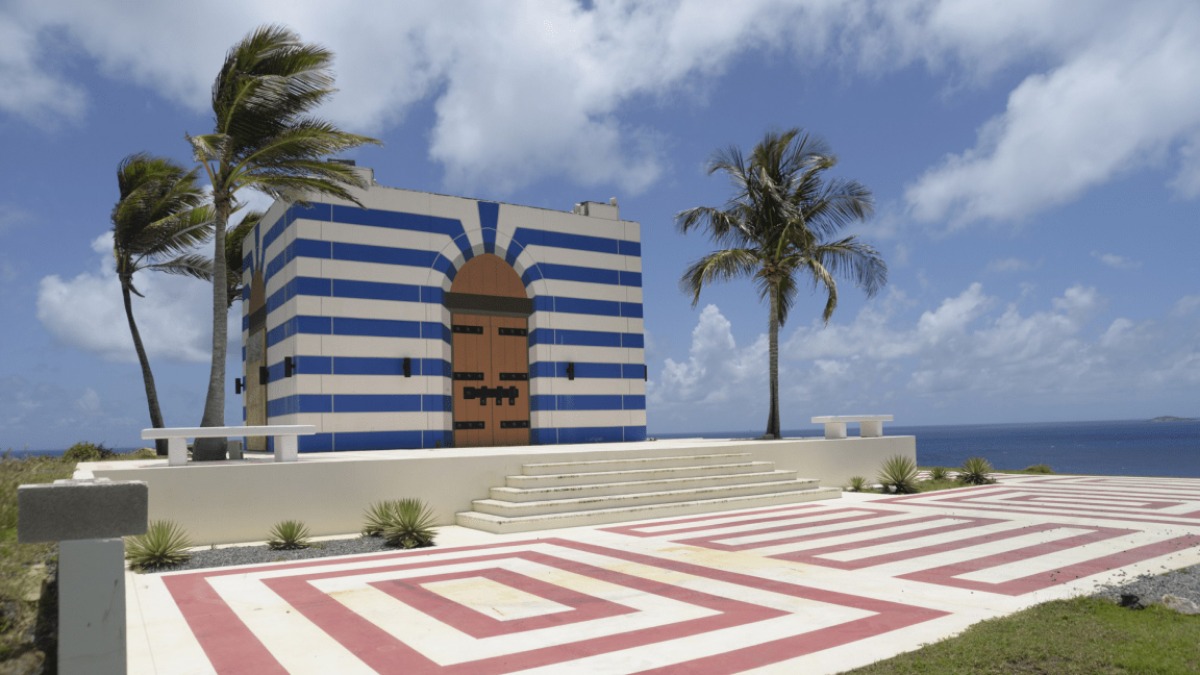
The bizarre blue-striped building on Jeffrey Epstein’s private island Little St. James, was actually a vanity project disguised as a mosque, complete with stolen holy relics from Islam’s most sacred sites. Newly released documents from the Epstein files reveal the structure, long the subject of wild conspiracy theories, was never intended for worship.
Instead, it was a grotesque passion project for the disgraced financier, who filled it with fragments of the Kaaba, the holiest object in Islam, and other priceless artifacts looted from Mecca. According to UNILAD, the building, topped with a gold dome and wrapped in blue-and-white stripes, was originally pitched to authorities as a music pavilion. But architectural plans and emails show Epstein had far more grandiose, and sacrilegious, ambitions.
He referred to it as his “mosque” in correspondence, despite being a secular Jew with no apparent religious ties to Islam. His obsession with Islamic aesthetics was well-documented, from his boasts about owning “the largest Persian rug you’ll ever see in a private home” to his fixation on ancient Middle Eastern design.
The mosque project took that fascination to a disturbing extreme
Emails from 2013 reveal Epstein’s inspiration for the building: the Yalbugah Hammam, a 500-year-old Mamluk bathhouse in Aleppo, Syria. He instructed architects to replicate its striped walls and golden dome, even demanding that Arabic calligraphy be replaced with his own initials.
“Instead of Allah, I thought J’s and E’s,” he wrote in a typo-riddled message to an artist hired for the project. The artist, Ion Nicola, confirmed that Epstein consistently called the structure his “mosque,” though it remains unclear if he ever intended it to function as one. What is clear is that Epstein didn’t just want the building to look like a mosque, he wanted it to house stolen relics from Islam’s most sacred sites.
In 2017, his assistant emailed a customs broker about receiving “3 pieces from the Kaaba,” the structure in Mecca that Muslims worldwide face during prayer. One of those pieces was a fragment of the Kiswa, the ornate black cloth that drapes the Kaaba, handwoven from 1,500 pounds of silk and 250 pounds of gold and silver thread.
The Kiswa is replaced annually during Hajj, and the old one is typically divided for charitable donations or royal gifts. Epstein’s acquisition of one was anything but charitable.
Aziza Al Ahmadi, a contact linked to the Saudi royal court, described the Kiswa’s significance in an email to Epstein. “The black piece was touched by minimum 10 million Muslims of different denominations, Sunni, Shia and others,” she wrote. “They walk around the Kaaba seven rounds then every one tries as much as they can to touch it and they kept their prayers, wishes, tears and hopes on this piece.”
The idea that Epstein, a convicted sex offender, would hoard such a sacred object for his private island is almost surreal. But it fits a pattern of his behavior: treating people, places, and even faith as props in his own twisted narrative.
Epstein’s connections to the Middle East were as transactional as they were bizarre
He spent years cultivating relationships with powerful figures, including Saudi Crown Prince Mohammed bin Salman, in pursuit of both business deals and rare Islamic artifacts. Through intermediaries like Norwegian diplomat Terje Rod-Larsen, Epstein secured a meeting with the crown prince in 2016, pitching himself as a financial adviser for Saudi Arabia’s plans to take Aramco public.
His Saudi ties also helped him acquire the Kaaba relics. Al Ahmadi, who worked for the royal court, facilitated the shipment of tapestries embroidered with Quranic verses, tiles from a mosque in Uzbekistan, and even a golden dome modeled after ancient Syrian architecture.
A 2014 photo shows Epstein and Emirati executive Sultan Ahmed bin Sulayem admiring one of the Kaaba tapestries in his New York townhouse. Bin Sulayem later resigned from his role as head of DP World, a Dubai ports company, amid fallout from his association with Epstein, according to the Seattle Times.
The mosque project was a yearslong obsession for Epstein, one that continued even as his legal troubles mounted. In 2017, Hurricane Maria damaged some of the artifacts on Little St. James, but the storm was the least of his problems.
That same year, the crown prince distanced himself from Epstein, who complained in a text to Rod-Larsen that “the kingdom needs lots of expensive help now as they did not follow the jew directions.” The following year, journalist Jamal Khashoggi was murdered in the Saudi consulate in Istanbul, an event that cast a shadow over the crown prince, and, by extension, Epstein’s network.
By 2019, Epstein’s world was unraveling
A Miami Herald investigation exposed the details of his 2008 plea deal, which had granted him immunity from federal prosecution in exchange for a lenient sentence. He was arrested on new sex trafficking charges in July of that year.
Days before his death in a federal jail cell, he transferred ownership of Little St. James to a private trust. The mosque, with its stolen relics and grotesque vanity, remains a haunting monument to his delusions of grandeur.
The Epstein Files don’t just reveal the depravity of one man; they expose how easily power, wealth, and influence can distort reality. Epstein didn’t just collect art or build extravagant structures. He treated faith, culture, and human dignity as commodities to be bought, stolen, and repurposed for his own amusement. The mosque on Little St. James wasn’t a place of worship. It was a trophy case for a predator who saw the world as his personal playground.
(Featured image: Federal Bureau of Investigation)
Have a tip we should know? [email protected]
Follow The Mary Sue:
