


Black Woman Confronts Librarian at Beaverton Main Library and Says ‘This Is Number Two.’ She Recorded Everything
Weeding out bias.
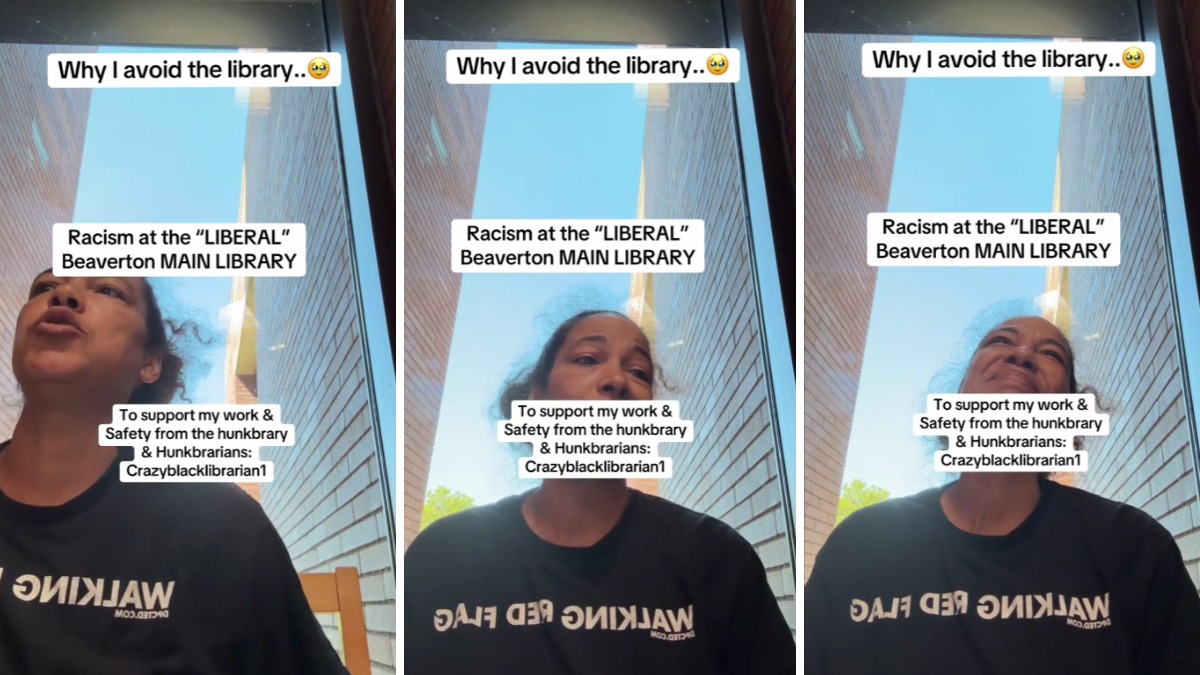
A Black woman and racial literacy advocate just called out staff at Beaverton Main Library in Oregon for what she says is repeated racial targeting, and the video of her confrontation is making waves online. CB_Whitabetes_01 (@hunkeh_tamer2) on TikTok, who often uses the moniker ‘Crazy Black Librarian’, recorded the entire exchange, detailing how this was the second time she’d been singled out while white patrons with disruptive children were ignored.
In the clip, she directly challenges a library employee, asking what she should do if it happens a third time. The staff member responds with an apology for making her “feel that way.” The moment underscores a larger issue: how even in spaces meant to be inclusive, like libraries, racial bias can show up in subtle ways.
For @hunkeh_tamer2, this isn’t just a personal grievance. It’s part of a broader mission to expose what she calls “whitabetes,” a framework she uses to address anti-Blackness, systemic bias, and the ways whiteness shapes institutions.
The video starts with her recounting the incident in real time
She describes how, for the last five to ten minutes, she’d been listening to a young woman allow her children to run around the library without any restrictions. The kids were loud, disruptive, and seemingly unsupervised, yet no staff member intervened. Meanwhile, she – a Black woman sitting in a corner using headphones – was approached by library staff. The discrepancy was glaring, and she wasn’t afraid to point it out.
“Can you explain the difference for me,” she asks the librarian, “why she’s able to be disruptive, disrespectful, but I as a Black person in the library minding my own business in a corner actually gets approached?” The librarian attempts to clarify, mentioning a child in a nearby cubicle, but @hunkeh_tamer2 cuts through the deflection.
“There’s two of them,” she says, pointing out the obvious. “You didn’t hear those kids running around here just now? Running around the library? You can hear them. Everyone heard them running around.”
The librarian acknowledges the noise but doesn’t address the core issue – why @hunkeh_tamer2 was targeted instead of the disruptive children. That’s when she said, “This is number two.” She explains that this is the second time she’s been approached under similar circumstances, while white patrons with loud, unruly kids are left alone. The first time, she gave the library “grace and leniency.” But now, she’s done extending that patience.
“What should I do the third time?”
“Is that when I need to go ahead and file a complaint? Where are you guys gonna go ahead and get this together? Because I’m getting really tired of experiencing racism here,” the creator says Her frustration is palpable, and it’s not just about this one incident. She’s been working on a book about white privilege, white culture, and systemic racism, and her experiences at Beaverton Main Library have become part of that research.
“I literally have to brace myself to come up through the doors here because I anticipate this,” she says. “And that is the problem. When we anticipate to experience racism in a predominantly white institution, place, space, that means there’s some problems with you guys.”
The librarian offers to connect her with the library director, but @hunkeh_tamer2 isn’t interested. She’s already met with the director, who dismissed her concerns by pointing to the library’s DEI (Diversity, Equity, and Inclusion) training. “That only benefited white T people for the most part, white women specifically,” she says. “That’s usually why a lot of leadership all of a sudden have a lot of white T. But these are the stats. This is the education.”
For her, the training clearly hasn’t translated into real change
What makes this video so compelling is how it blends personal testimony with broader systemic critique. @hunkeh_tamer2 uses humor, directness, and lived experience to highlight how racial bias operates in everyday spaces.
Her platform, which she brands as the “Whitabetes Treatment Center,” is all about equipping people with the tools to recognize and challenge systemic racism. Whether through live sessions, cultural commentary, or resources, she’s built a following by making complex topics accessible and relatable.
Libraries are supposed to be neutral, inclusive spaces where everyone feels welcome. But for many people of color, they can become sites of microaggressions, profiling, and frustration. @hunkeh_tamer2’s video is a stark reminder that even in progressive areas like Beaverton, Oregon, racial inequities persist.
Her story isn’t unique
However, her willingness to continuously document and share it publicly is significant. It’s a call for accountability, not just from the Beaverton Main Library but from institutions everywhere that claim to value diversity but fail to put those values into practice.
The employee asks if there’s anything they can do for @hunkeh_tamer2 at that moment. Her response is simple but powerful: “Actually, no, I don’t think there is. But possibly, you know, have little conversations with the librarians here who are racist. Even the one I think has a Black daughter, she’s especially racist.” It’s a blunt assessment. It’s also an offer to help the library address its issues if they’re willing to listen.
For now, @hunkeh_tamer2’s video is serving as both a personal catharsis and a public service. It’s giving voice to experiences that too often go unheard and unaddressed. And it’s a reminder that racial literacy isn’t just a buzzword – it’s a necessary skill for navigating a world where bias is still deeply embedded in the systems we interact with every day.
(Featured images: Veronica Gunn CB_Whitabetes_01 @hunkeh_tamer2 on TikTok)
Have a tip we should know? [email protected]
Follow The Mary Sue:
