


Darren Aronofsky Is Teaming Up With…AI?
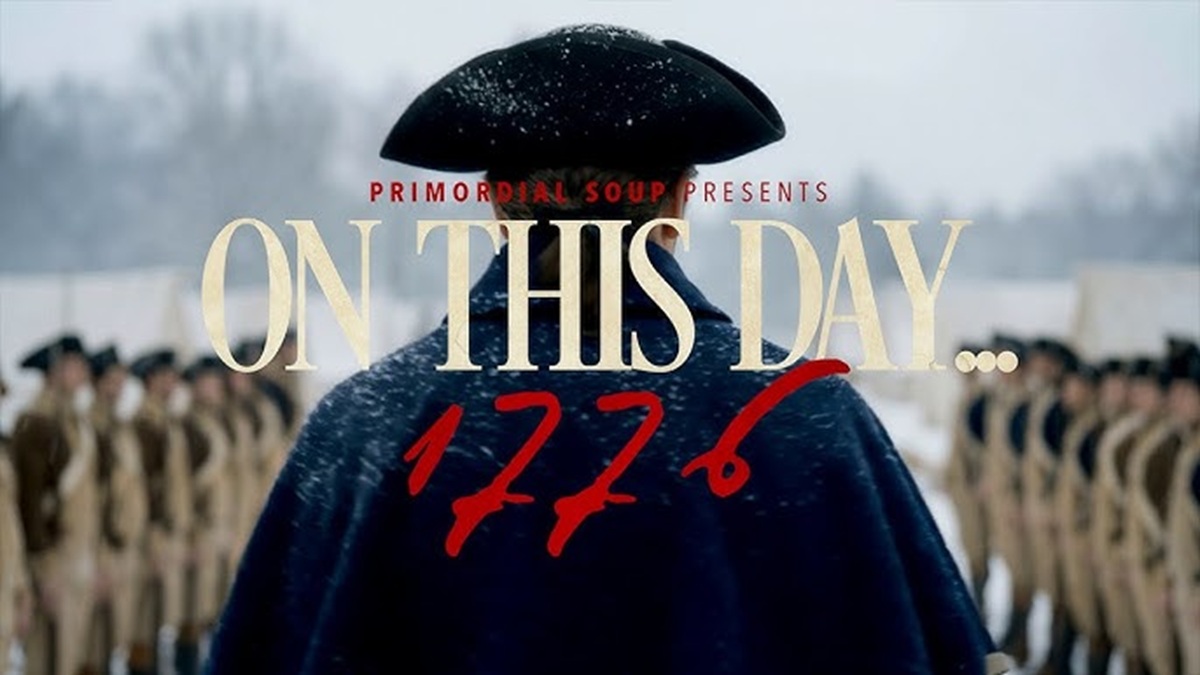
If you needed more convincing that Darren Aronofsky is only in the movie business to make people uncomfortable, then buckle up, because his next spectacle once again pushes the envelope in a way nobody asked for: A web series about the Revolutionary War, produced with AI.
Aronofsky’s AI production company Primordial Soup (yes, that’s the real name, and yes, it’s exactly as pretentious as it sounds) has unleashed On This Day… 1776 upon an unsuspecting world. The short-form series, created in partnership with Google DeepMind and distributed through Time Magazine’s YouTube channel, promises to recreate pivotal moments from America’s founding year using the magic of, uh, artificial intelligence.
Not cameras or elaborate historical set pieces. AI as in using the same models that are currently being scrutinized for plagiarism and copyright by thousands of artists around the world.
The series bills itself as a thoughtful hybrid approach, combining AI-generated visuals with SAG-AFTRA voice actors, human writers led by Lucas Sussman, and traditional post-production work. According to Time Studios president Ben Bitonti (per TechRadar), this represents “what thoughtful, creative, artist-led use of AI can look like—not replacing craft, but expanding what’s possible.”
That’s certainly one way to describe it. Not that it’s convincing, though. At least not as long as this pesky little thought occurs that maybe they could just spend more money and make, you know, an actual web series, paying actual people with actual talent to create what the AI did for them.
The first two episodes feature George Washington raising the Continental Union Flag and Benjamin Franklin convincing Thomas Paine to write Common Sense. What they actually deliver is a masterclass in why some technologies aren’t ready for prime time, featuring dead-eyed characters with lips that sync to dialogue about as well as a dubbed spaghetti western, except without the charm or the Ennio Morricone soundtrack.
The only people showing any measure of common sense in this instance are the users, who have been surprisingly efficient and brutal in their takedown of On This Day… 1776.
“This is why RAM costs $1,000 now,” wrote one user on the YouTube trailer page, referencing the surge in the price of memory sticks due to AI companies hoarding chips for their data centers.
“I didn’t know the American Revolution took place in the Uncanny Valley,” quipped another user, while someone else expressed what we’re all thinking in 2026 on the precipice of the AI dystopia: “What a terrible time to have eyes.”
The project is a disaster, so why is Darren Aronofsky so keen on using AI?
Aronofsky’s filmography is a carefully curated collection of psychological torment — from the spiral-staircase descent of Requiem for a Dream to Natalie Portman peeling her own skin off and realizing that in the director’s dictionary, method acting is no different than actual psychosis — the man is here to offer his unique take on cinematic excellence. That often involves hurting your brain with non-linear storytelling and the magic of deft editing, making viewers feel like they need a cigarette and a lie-down, and they don’t even smoke.
When it comes to avant-garde cinema, it doesn’t get any more brilliantly deranged than Darren Aronofsky. So it’s particularly baffling why he’s doubling down on harnessing AI tools to make movies. In an August 2025 interview with The Guardian, he argued that storytellers need to utilize AI tools before someone else does, dismissing the pushback against AI, especially by artists, as nonsensical.
“These tools are coming. They’re being used at an incredible adoption rate, but they’re mostly being used for slop,” he said. “So I feel that, as storytellers, we need to harness these tools to help us do our work. There are a lot of artists who are fighting against AI, but I don’t see that as making any sense. If we don’t shape these tools, somebody else will.”
Except, this logic only works if the technology is capable of producing something worth watching. Something that, in Aronofsky’s own words, isn’t “slop.” Well, On This Day… 1776 certainly disproves that theory, with some outlets going so far as to accuse it of ruining American history.
Here’s the uncomfortable truth Aronofsky seems unwilling to acknowledge. AI isn’t a neutral tool waiting to be shaped by visionary auteurs. It’s a content-generating machine trained on the stolen intellectual property of actual artists, currently subsidized by venture capital in hopes that people will eventually accept its limitations as the new normal.
Then again, this isn’t even the strangest creative decision the Black Swan director has made recently.
If there’s one thing On This Day… 1776 proves, it’s that there’s a reason we hire cinematographers, set designers, animators, and actors: they are capable of making things that don’t like the half-baked, discomforting stuff we see in our nightmares.
(featured image: Primordial Soup/TIME)
Have a tip we should know? [email protected]
Follow The Mary Sue:
