comScore
  1. Mediaite
  2. Gossip Cop
  3. Geekosystem
  4. Styleite
  5. SportsGrid
  6. The Mary Sue
  7. The Jane Dough
  8. The Braiser

Misleading Headline of the Day

Mermaids Confirmed (To Not Exist)


Intent upon totally spoiling everyone’s deep sea dreams, The U.S. National Oceanic and Atmospheric Administration has issued a definitive statement on mermaids. Um, what?

Basically, they explained that they don’t exist.

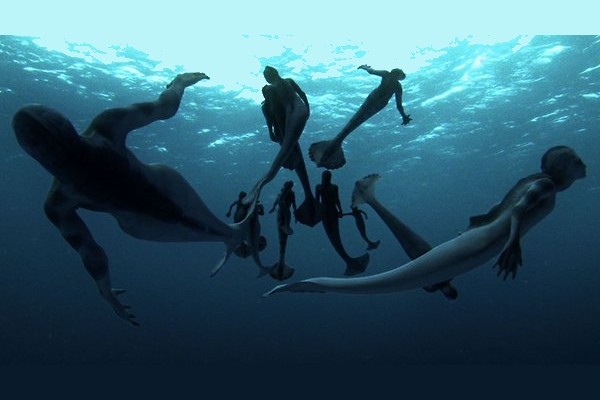
Before you scream government cover-up, NOAA is responding to the show Mermaids: The Body Found, an Animal Planet (Discovery Channel’s partner network) “documentary” that “paints a wildly convincing picture of the existence of mermaids, what they may look like, and why they’ve stayed hidden…until now,” according to the show’s press page. The show mixes real and fake footage, legitimate science such as the “aquatic ape” theory  (“suggesting our evolutionary ancestors may have lived in marine environments”), conspiracy theory, and real interviews with NOAA scientists. Whoops, bet you guys didn’t think you’d be roped into neither confirming nor denying the existence of a mythical being on a conspiracy show à la Ancient Aliens!

Apparently, the show provoked enough public inquiries about the existence of mermaids that NOAA felt the need to step in and dash all the dreams of young children everywhere who still think Ariel from The Little Mermaid is real:

The belief in mermaids may have arisen at the very dawn of our species. Magical female figures first appear in cave paintings in the late Paleolithic (Stone Age) period some 30,000 years ago, when modern humans gained dominion over the land and, presumably, began to sail the seas. Half-human creatures, called chimeras, also abound in mythology — in addition to mermaids, there were wise centaurs, wild satyrs, and frightful minotaurs, to name but a few. But are mermaids real? No evidence of aquatic humanoids has ever been found.

But…just because no evidence of aquatic humanoids has ever been found, doesn’t mean it doesn’t exist, right? Right? I’m just saying, barring the existence of mythical creatures, what reason do we really have to watch the Discovery Channel, Animal Planet, and the History Channel now?

(via i09.)

TAGS: | | |


  • Anonymous

    The existence of mermaids is being covered up by Hitler’s UFO allies.  The History Channel told me so. :P

  • http://twitter.com/WanderinDreamr Helen the Dreamer

    Hmm, are these the same people who did the “documentary” on dragons four or five years back? Sounds kinda similar….

  • Jenn Kluska

    Isn’t that the one that was basically a rip off of the animated film “Flight of Dragons” (1982) by Rankin/Bass?

  • http://wrongsirwrong.blogspot.com/ Magic Xylophone

    It assimilated some of the scientific conjecture of the non-fiction book Flight of Dragons, on which the cartoon was based, but it was substantially different enough to avoid the label “rip off.”

  • http://wrongsirwrong.blogspot.com/ Magic Xylophone

    “Apparently, the show provoked enough public inquiries about the existence of mermaids”

    Come on, people. This is embarrassing.

  • Anonymous

    If mermaids don’t exist who stole my swim suit?

  • Anonymous

     Selkies, obviously. It’s not like you can expect them to just walk around naked, what are you, inconsiderate?

  • http://www.wordflow.webs.com/ Invisible_Jester89

    Who is seriously stupid enough to actually believe a mockumentary on mermaids from the same people who gave us Dragons: A Fantasy Made Real, The Future Is Wild, and Walking With Dinosaurs? Seriously, now? Really, people?

    You all fail common sense forever. >.<

  • http://www.wordflow.webs.com/ Invisible_Jester89

     Yeah, I think it’s the same people. That was actually pretty interesting to watch; then again, I collect dragons, so… ^^”

    Dragons: A Fantasy Made Real was the name of the mockumetary, and it was pure speculation on what dragons would have been like if they actually existed – how they might have evolved, what they might have actually looked like, how they might have behaved. I suspect this one about mermaids is similar, and I am looking forward to seeing it.

  • http://www.wordflow.webs.com/ Invisible_Jester89

    Um, no, actually it’s not a rip-off of Flight of Dragons in any way. Not even close. Flight of Dragons was an animated fantasy film. Dragons: A Fantasy Made Real (the speculative sci-fi special) was a “mockumentary” in the same vein as Walking With Dinosaurs, and the dragons in the special were much different. Maybe you mixed up the titles or something, but the two are in no way related. :)

  • http://www.wordflow.webs.com/ Invisible_Jester89

     Ah, good ol’ Alternate History Channel. :)

  • Anonymous

     http://lnk.co/I0RQG

  • http://twitter.com/NeeniDeLamere Neeni de Lamere

    The one thing I have noticed with scientists and researchers is that they are always trying to prove that things do not exist. Honestly, that is kind of impossible, especially in a world as vast and uncertain as ours. You can prove something does exist or did exist, but you will never have solid proof that something does not exist. So many creatures have gone unnoticed until now, creatures we all had assumed to be mythological. So while we have no proof supporting the existence of mermaids, we are far from claiming that they do not exist at all.

  • Anonymous

    Aww, I think you’re being a little too hard on researchers. The text on the NOAA  page, for example, doesn’t say “no, mermaids don’t exist,” so much as “there is no proof.” Sure, there are probably examples of researchers (scientific or otherwise) saying that X or Y doesn’t or couldn’t exist, but there are probably just as many reports that are phrased in the same way as the mermaid story on the NOAA’s website. Also, I suspect that if one were to look behind the more black and white statements there would be a wealth of research, reasoning, and study that’s taken into account as many possibilities as could be imagined.

    I think it’s fair to say that most good researchers are less interested in disproving things than in evaluating all available facts as objectively as possible (as opposed to examining only the facts that support a given conclusion). While I’m sure there are researchers who fudge results for whatever reason, a good researcher will start a project with an open mind and not overstate or understate the evidence he or she finds. It really isn’t their fault if they rarely find definitive evidence of mermaids, X, Y, or Z. As you said, the world is vast and uncertain. All a responsible scientist or researcher can do is state things of which he or she *is* certain. :)

X