


Texas woman recreates a 1997 H-E-B grocery bill with 122 items. Here’s how much the total has changed
I did not need this realization today.

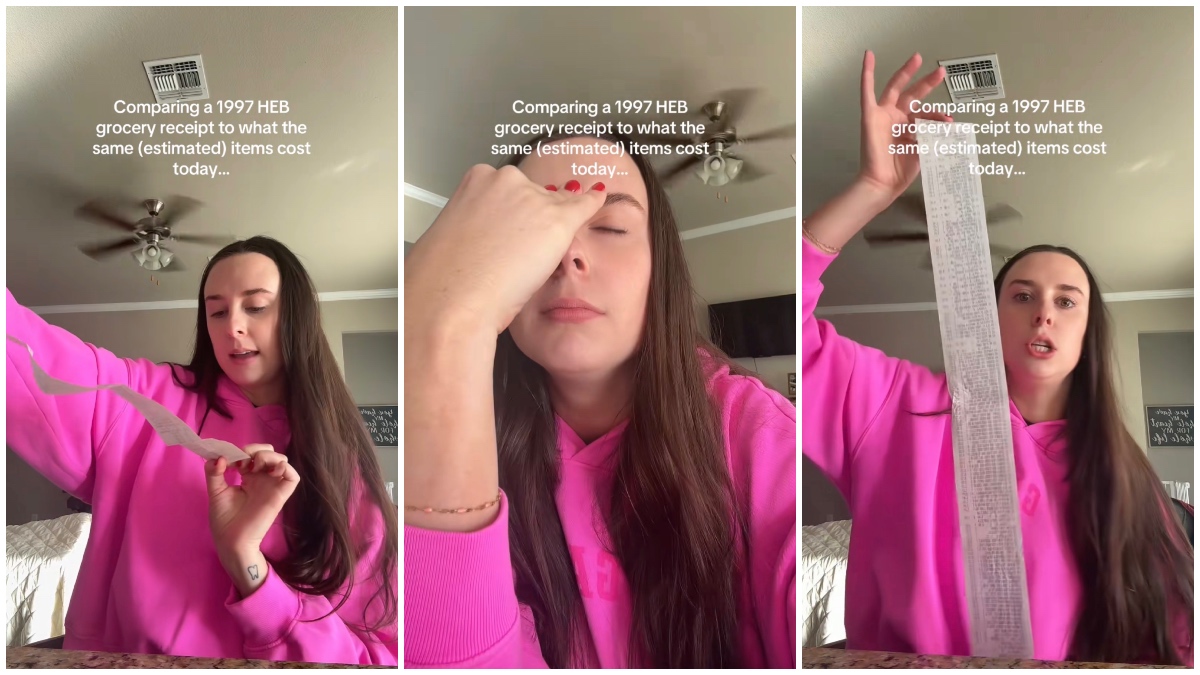
A trip to the grocery store these days feels more like a heist against our savings accounts lately. But seeing the cold, hard numbers side-by-side is a different kind of pain. TikTok creator Zoe Dippel (@zoedippel) recently struck a nerve with over 738,000 viewers after she unearthed a 1997 H-E-B bill saved by her mother-in-law.
The document serves as a time capsule from a world where you could feed a family, including twins, without taking out a second mortgage. Zoe decided to run a modern-day experiment by plugging all 122 items from that 1997 haul into the H-E-B curbside app to see what they would cost in 2026. The results are a stark indicator of just how much the cost of living has mutated over the last three decades.
The ‘90s grocery bill breakdown
The price jumps for individual household staples are nothing short of staggering. Zoe highlighted several items that have seen their prices double, triple, or even quadruple since the late ’90s. For example, Cantaloupes were a mere $0.77 each, they now ring up at $2.58. A jar of honey that cost $2.49 in 1997 has skyrocketed to $9.95.
Next on the list, Little Debbie’s Brownies jumped from $1.09 to $5.75. They were once the lunchbox classic. A 22-count pack of State Fair Corn Dogs also went from a budget-friendly $2.49 to a whopping $14.30. Even essential grocery items like Pampers jumped to unreasonably high numbers. A large 78-count box for the family’s twins cost $12.99 then; it’s $31.47 today.
Even coffee, the fuel for the working class, surged from $2.47 to $9.43 for a bag of ground beans. As Zoe aptly put it during her recap, “How are we supposed to survive?”
The $500 reality check
The final total is the ultimate rebuttal to anyone claiming that inflation isn’t that bad. In 1997, that mother-in-law walked out of H-E-B with 122 items, including baby food, diapers, wipes, meat, and fresh produce, for just $155. In 2026, those exact same 122 items totaled $504. That is more than a 225% increase in cost for the same amount of food and supplies.
For a family raising twins today, the “baby tax” alone makes the 1997 receipt look like a fantasy novel. Zoe described the comparison as “crazy” and “depressing,” noting that the haul covered everything a household could possibly need.
The wage gap math
The internet was quick to point out that it’s not just the prices that have changed. It’s also our ability to pay them. Users on TikTok noted that while grocery prices have exploded, wages in Texas have remained stubbornly stagnant.
In 1997, the Texas minimum wage was $5.15/hr. By 2025, it had only crawled to $7.25/hr. One user calculated that the same basket of goods now requires about 79% more work hours to purchase than it did in 1997. Another viewer noted that their current salary is identical to their father’s 1997 salary. Except, their father supported a stay-at-home wife and three kids, while they struggle with a dual-income household and two kids.
The internet couldn’t be more frustrated
The comments section of Zoe’s video turned into a collective vent session. It’s coming from a generation that feels like the goalposts of adulthood are being moved every time they hit the checkout line.
“My parents used to pay $650 rent for a 3 bed 2 bath home. I’m now getting charged $1500 for a 1 bed 1 bath,” one user remarked, highlighting that the crisis extends far beyond the pantry.
“I did the math… groceries you listed cost 307.5% more,” a self-proclaimed nerd added, correcting the scale of the increase. “This is exactly why we cut it close every month,” another parent shared.
Nostalgia shouldn’t be the only way to afford grocery
Zoe’s viral experiment is a reminder that the “good old days” were actually just days when people could afford to eat. When the experience of buying 122 items goes from a manageable $155 to a soul-crushing $504, the economic system is clearly failing the very people it’s supposed to serve.
As a fun experiment, you might want to hold onto your current receipts too. So that in 30 years, you can show your grandkids what a “cheap” $500 grocery bill looked like.
Have a tip we should know? [email protected]
