



Yes, it’s OK to Laugh with ‘Pillion’ [EXCLUSIVE]
Sticks and stones may break my bones, but, you know...

If it surprises you that the reactions to Pillion, the new film from director Harry Lighton starring Harry Melling and Alexander Skarsgård about a brief encounter relationship set in the seemingly aggro world of BDSM and bikers un-ironically include words like “sweet,” “charming,” “romantic,” and most importantly “funny” and “hilarious,” I’m here to assure you that that this dom rom is, in fact, a com. The Mary Sue spoke to Lighton and Melling about bringing that joyful tone to life on screen and inviting Pillion audiences to laugh.
The film is an adaptation of Adam Mars-Jones’ 2020 novel Box Hill. It follows Colin (Melling) and his revelatory coming-of-age journey at 35 years old. The dom-sub relationship he enters into with an enigmatic biker named Ray (Skarsgård) takes him about as far out of his cozy suburban British comfort zone as possible. It’s a celebration of subculture, pushing back against society’s conventions, and love. Discovering your own boundaries and preferences is fun work, but still work. It’s touching, thoughtful, sometimes quite sad, and also very funny.
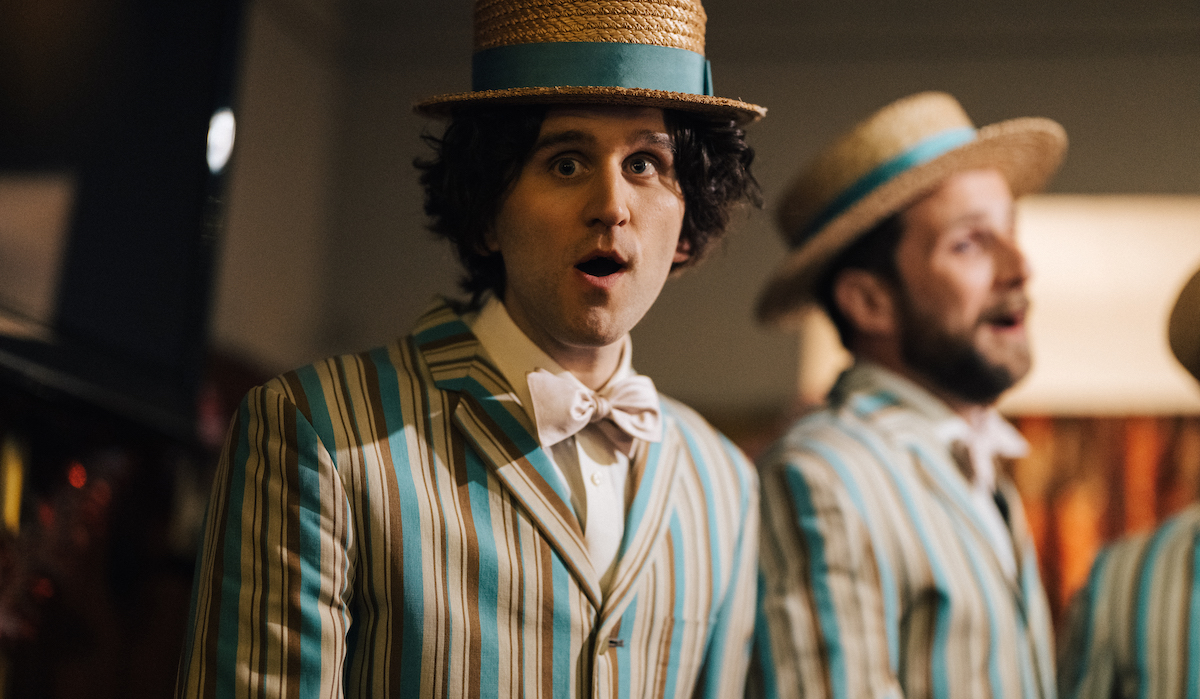
“The tone was a part of the book,” Lighton says, “which really appealed to me. It sort of switches between like laugh-out-loud comedy and then sincerity on a sentence-to-sentence level. I knew it was something which I wanted to carry across into the film. But a lot of it’s achieved through first person narration in the book. So thinking of visual ways to do that, rather than relying on a voiceover, a lot of thought went into [writing] that. Everything from a sausage dog to a barbershop group can provide you with a little moment of comedy. I think, yeah, comedy is useful when you’re tackling a theme which some people might find kind of intense or off-putting [like] BDSM. It’s a way to invite an audience in and to make them kind of sympathize or empathize with characters.”
Levity was baked into Pillion‘s DNA
One very important goal, while developing Pillion with producers, was to “give the film a sort of inviting quality, which might appeal to a broader audience, without kind of diluting any of the specificity of the kink world we were portraying,” Lighton says. “Music is one way of making something enjoyable as a watching experience. So using pop tracks, using [Tiffany’s cover of “I Think We’re Alone Now”] to score the wrestling scene was one way we thought about doing that.”
Laughter is a release. Giggling is good. It’s shocking that this needs to be said in 2026, but enjoying the comedy in a sex comedy does not mean that you’re immature. It does not mean that you, or the film at that matter, are making fun of what is being depicted on screen either. Lighton, Melling, and Skarsgård took a lot of care into researching BDSM relationships and the Gay Bikers Motorcycle Club (GBMC) and making something niche feel emotionally universal. We’re laughing with, not at them. Communal laughter in a movie theater is one of the best things in the entire world. It’s our way of recognizing that we have shared experiences and are all, you know, human.
Melling and Lighton told TMS that they didn’t talk so much about the comedy before-hand. That said, it should be noted that Lighton has stated in previous interviews that he was interested in Melling for the role of Colin after watching his performance in the 2018 Coen Brothers’ anthology film The Ballad of Buster Scruggs, which is absolutely a comedy.) However, as both of The Harrys™ said, the tone was present in the book as well as the screenplay. (Which you can read online courtesy of A24, by the way, if you’re into that.)
Colin is an age-old comedic archetype in this unorthodox tale
“What’s useful about a character like Colin,” says Melling, “is he’s experiencing everything for the first time and so that in a way is a gift in terms of comedic moments, watching someone sort of try and understand this world and understand what the right thing to do in it is, is there’s lots of potential [for comedy] there.”
Colin operates as what comedy would traditionally call a “straight man” as opposed to Ray’s “crazy man” or comedic foil. It’s a fairly out-of-date term that doesn’t necessarily apply here on a linguistic level. However, alternative phrases line “voice of reason/agent of chaos” don’t really describe Colin and Ray’s whole deal either. The former is pretty enthusiastic about entering and adapting to his new environment and relationship. But as far as they function in the story, the dynamic is the same. Colin is the everyman audience surrogate and Ray represents the unfamiliar and the unconventional. It makes the comedy come easily.
“I sort of quickly forgot that I had to be funny,” Melling continued, “because if I did, that would be, well, I wouldn’t… I wouldn’t have been funny.”
You can watch our full chat here.
(featured image: A24)
Have a tip we should know? [email protected]
