


An influencer claims ‘headphones are making you gay’ because of, well, a misquoted scientific study

According to right-wing influencer Ian Miles Cheong, wearing certain headphone brands can turn you gay. Is there any truth to this, or is he inciting panic for engagement’s sake?
Cheong wrote on X, “Your headphones are making you gay.” He cited a scientific paper from Arnika, an NGO, to support his claim.
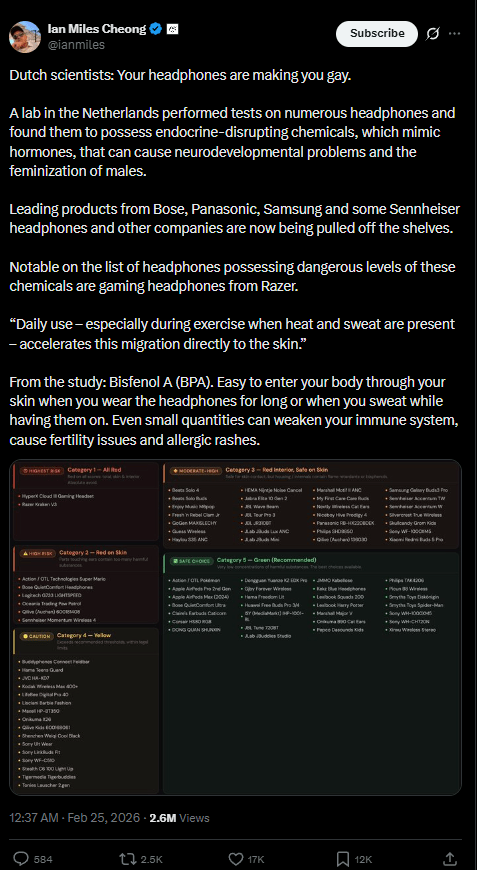
He further elaborated, “A lab in the Netherlands performed tests on numerous headphones and found them to possess endocrine-disrupting chemicals, which mimic hormones, that can cause neurodevelopmental problems and the feminization of males.”
Those in the replies seem to agree, far more afraid of becoming gay than Googling what endocrine disruptors actually do.
The paper Cheong cited, ‘The Sound of Contamination: A Comprehensive Analysis of Endocrine Disruptors and Hazardous Additives in the Headphones,’ is a study on several headphone brands. The researchers analyzed 81 headphone models across Central Europe and discovered that 100% of the products contained several harmful substances that could put public health at risk with long-term exposure.
Does one of the risks involve becoming gay?
The short answer is no. Bisphenols, phthalates, and flame retardants are endocrine disruptors, but endocrine disruptors have nothing to do with sexual preferences. However, endocrine disruptors may contribute to cancer, diabetes, obesity, metabolic syndrome, and infertility, according to the National Center for Biotechnology Information.
Simply put, it’s a misunderstanding to assume that endocrine disruptors turn people gay. A person can be infertile but still have a preference for the opposite gender—essentially, there’s no correlation between these cases.
If there’s anything to be afraid of, it’s being slowly poisoned by headphones manufactured by a reputable brand.
Is it time to toss those headphones to the bin?
Thankfully, the study from Arnika claims that even if all the tested headphones contain harmful substances, some only have low doses or have minimal risk of chemical migration. The ‘safe’ headphones, as concluded by the NGO, are labeled ‘green,’ while the headphones that they deemed to be risky are considered ‘red.’
Don’t throw headphones out just yet—check Arnika’s study and see their recommended brands in Annex 1 of the paper.
Have a tip we should know? [email protected]
