


A Texas bill could ban ‘furries’ from public schools—yes, really


Texas lawmakers first came for vaguely suspicious anime. Now they’re coming after the “furries.” In a newly proposed house bill, Texas legislators are aiming to crack down on what they believe to be the “furry subculture.”
Related: Hungary just made all LGBTQ+ Pride events illegal and MAGA is desperate to do the same in the USA on We Got This Covered
HB 4814, otherwise known as the “FURRIES” Act, will “prohibit the accommodation or allowance of distracting or unhealthy roleplaying behavior.” That includes barking, hissing, and imitating animal noises. In addition, students will be prohibited from “using the litterbox” as a toilet and “licking” other people for the sake of grooming.
Accessories such as animal ears, tails, leashes, and collars will also be targeted by the ban. Halloween, dress-up days, and other school events will be exempt.
Representative Stan Gerdes justified the filing of the bill on X. He wrote, “Concerns have been raised that some schools have even provided litter boxes for students identifying as animals.” Gerdes thinks being a “furry” can distract students from learning. If the bill becomes a law, all schools in the 17th district of Texas will have to enforce it.
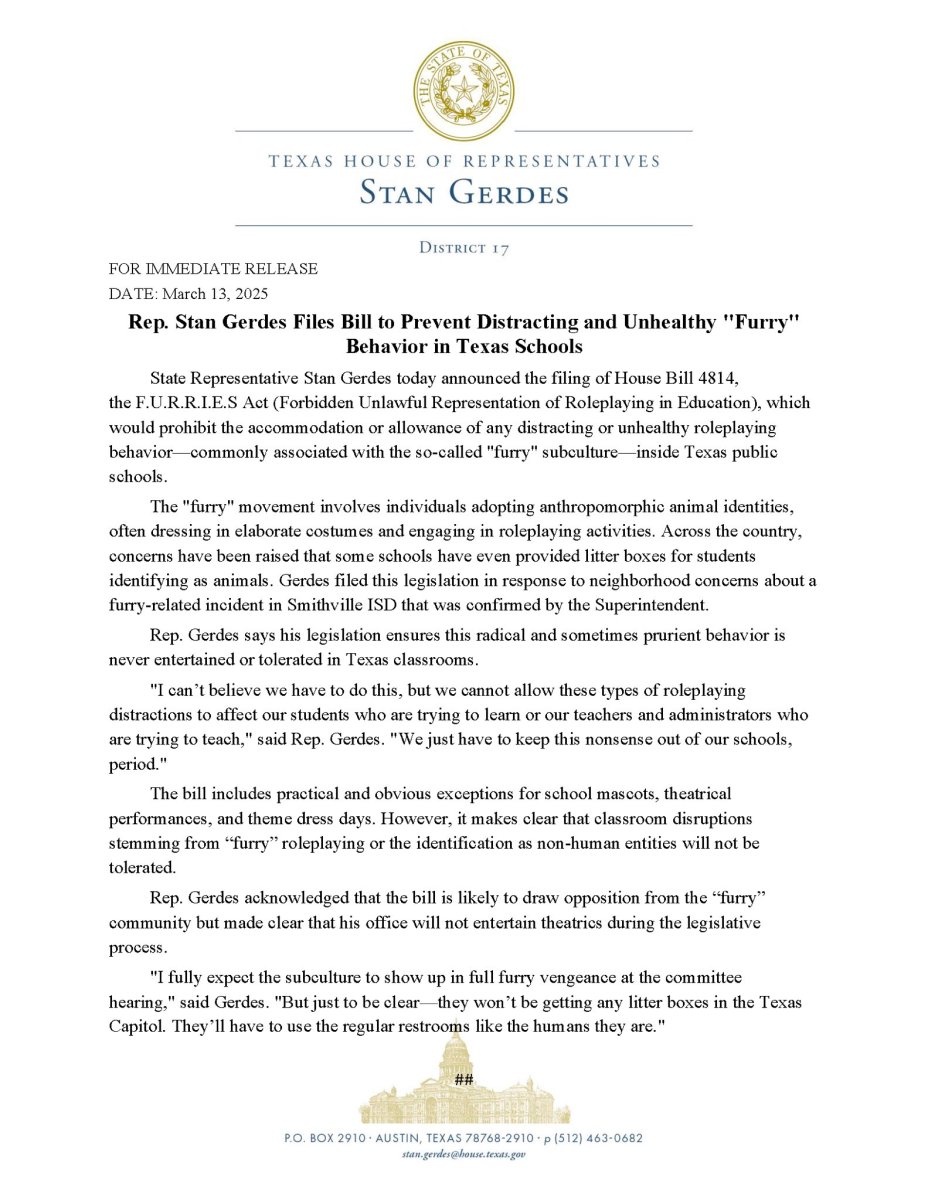
In a press release about the bill, Gerdes was quoted: “I fully expect the subculture to show up in full furry vengeance at the committee hearing, but just to be clear—they won’t be getting any litter boxes in the Texas Capitol. They’ll have to use regular restrooms like the humans they are.” Somehow, this is the timeline we live in now.
It seems that cat-ear headbands have replaced the classic shoulder strap and skirt length complaint from conservatives. But while Gerdes rails against alternative fashion, his bill misrepresents the furry subculture.
What are furries?
Furries do not use “human litterboxes.” This has been a repeatedly debunked urban myth often brought up by Republicans. It’s come to a point where oppositional voices are starting to meme this allegation. Similarly, furries communicate through human languages—not by barking or hissing.
Most importantly, furries don’t necessarily identify as animals—these people are just roleplaying animal “fursonas.” They create non-human personalities (fursonas) to help express traits that they would otherwise be shy to do so in their human form. It’s a form of escapism among the furry subculture.
“This becomes a really good point of being able to communicate in ways that are socially supported,” sociologist Dr. Sharon Roberts said about the fursona. She explained to PBS Voices that people who struggle socially or with autism are able to express themselves better with a fursona. Moreover, she revealed that 85% of furries are from the LGBTQ+ community.
Even the bill concedes that furries are merely role-playing, although it claims they are doing so in an “unhealthy” way. Herein lies the problem—do legislators then think that furries identify as animals, or do they recognize that this is just creative and harmless self-expression? This is a question for the Senate to rule out.
Arguably, this bill intersects with the right to self-expression. Even those who aren’t furries have cause to be concerned. After all, per the bill’s logic, people who wear adorable cat-ear headbands are furries, even if they aren’t. The same goes for choker necklaces and other fashion accessories associated with pets. Being fashionable never hurt anyone—except morally panicked Republicans.
Have a tip we should know? [email protected]
