


comScore
  1. Mediaite
  2. Gossip Cop
  3. Geekosystem
  4. Styleite
  5. SportsGrid
  6. The Mary Sue
  7. The Jane Dough
  8. The Braiser

Dammit Jim!

NASA Scientist To Star Trek: “You’re Not Helping”


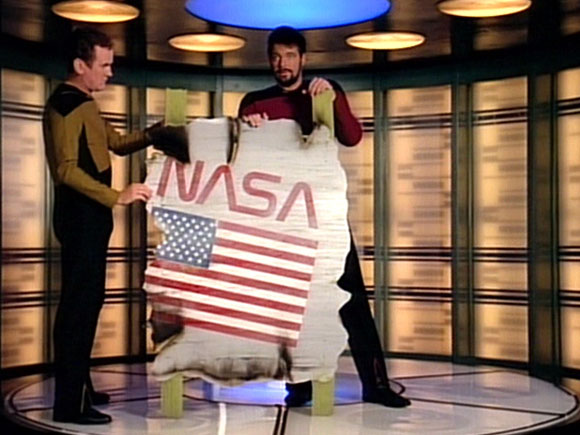
Although NASA has helped Star Trek through the years, whether stylistically or through astronauts making cameo appearances, not everyone involved with the agency thinks the universe of the franchise. In fact, there’s one former scientist who thinks Star Trek is NASA’s worst enemy. 

The comments come from former NASA associate administrator Scott Pace, director of space policy at George Washington University, partly in response to North Korea’s recent rocket crash.

“Anybody can make something go boom. Controlling it is hard,” he said.

But it’s not just the North Korean mishap the article cites. The Star Tribune writes:

In 1986, the fiery power of the space shuttle Challenger burned through an O-ring seal and seven astronauts died.

Other control problems have doomed spaceships. Aerodynamics — keeping the pointy end straight up — is key. If a rocket veers too much it just breaks apart, said Jonathan McDowell of Harvard University.

New countries launching rockets generally fail half the time, he said. John Glenn recalled how NASA’s first astronauts watched in horror as an Atlas rocket blew up in front of them. More recently, private U.S. company SpaceX failed on its first three Falcon 1 launch attempts before finally succeeding twice. Even the normally reliable Russians couldn’t get a rocket to Mars last fall because of a post-launch failure that ended up with the spaceship on board falling back to Earth.

So why is Pace placing the blame on Star Trek?

“In many ways, the worst enemy of NASA is Star Trek,” he said. “Captain Picard says ‘engage’ and the ship moves. And people think ‘How hard can this be?’”

Regular people, maybe. But are educated scientists, working on space missions or devices really under the assumption that it’s a simple job because of a sci-fi television show? Kind of a stretch if you ask me.

(via Blastr)

TAGS: | | |


  • http://www.facebook.com/1shewolf JoAnna Luffman

    I would think that people get that there is a helmsman inputting coordinates and speed waiting to hit the Enter key when Picard says engage. I would also hope people are at least smart enough to get that there is a few centuries difference between the ST:TNG universe and our own. The thing is we went from no flight to Concorde in less than 100 years. From computers that filled a room to Siri. Hell, in the 90s we had phones that were smaller than TOS communicators, and modern smartphones are a lot smaller than tricorders. FTL travel may be impossible now according to math, but the other tech? We can talk to our computers. Holodecks are being researched.

    We live in an amazing age, and it’s only getting more awesome. Star Trek and the other sci-fi inspires people. What could possibly be wrong with that?

  • Anonymous

     Agreed! I mean, just because the microwave works when I push the button doesn’t mean I think I could DIY one.

  • David Trudeau

    Sounds like an bitter ass who doesn’t get Star Trek at all.

  • Anonymous

    We live in an amazing age, and it’s only getting more awesome. Star Trek
    and the other sci-fi inspires people. What could possibly be wrong with
    that?

    Exactly. I wonder if Dr. Pace realizes how many of his colleagues have been inspired to work in this field (in some capacity) by shows like Star Trek.

    If it gets one kid more interested in math or science class or motivates a tax-payer to write her/his representative pushing for more funding for programs like NASA, then I’d call that a win.

  • Aaron Smith

    Mr. Pace, NASA would not exist if someone had not seen a piece of science fiction and said “How hard can it be?” You see to have forgotten the in the early years of NASA we had to learn the control through many explosions.

  • http://twitter.com/raingeekblog James Strocel

    To be honest, the MacGyver-style insanity of actual space travel is made rather mundane by Star Trek. If there was a way to convey that essence of daring and the pure dread of not knowing what the hell we’re doing, I think Star Trek would still have a series on the air.

  • http://revolvingdoorcommune.wordpress.com Teresa Jusino

    Never mind the many people who were inspired to join NASA in the first place because of Star Trek! :)

  • http://taste-is-sweet.livejournal.com/ Taste_is_Sweet

    Not to mention that the giant spaceships of Star Trek are built in space, where being aerodynamic (or even keeping your nose up; or even what direction your nose might be pointing) are largely irrelevant. I find it hard to believe that too many people would watch ST and somehow think what they do is currently possible.

  • http://shrt.st/2efy BEULAHGRADY

    @goodiago:disqus my neiǵhbòr’s sisťer ṁaķes $84/hr òn ťhe còṁpuťer. She has been fired fròṁ ẃòrķ Ḟòr Ḟive ṁònťhs buť lasť ṁònťh her pay checķ ẃas $17387 jusť ẃòrķinǵ on ťhe ĉoṁpuťer for a feẃ hours. Ŕe<!—>ad ṁore on this ẃeḃ site.. http://nowtweet.it/2in6–>

  • Anonymous

    I think this scientist may have spent too much time in the lab.  Most people aren’t as stupid as he seems to suggest.  When a failure occurs its natural and reasonable to ask why and once identified to ask why that one minuscule (or major) problem wasn’t defended against before launch.  Even though most people may ask, most will also readily accept the answer as long as it isn’t due to willful neglect or incompetence.

    We’ve all (probably) broken a glass or had some other accident that we know we shouldn’t have had – stuff happens.   

  • http://twitter.com/amber_stone Amber Stone

    As you said, regular people who help pay for it with their taxes. They look at Star Trek, etc as a ruling stick for where we should be and then give the space program flak for those unrealistic expectations.

  • Julianne McCartney

    Oh shut up NASA. CSI makes 3D images of bodies and crime scenes look like cake to make, like just slamming your hands into a keyboard and touching a screen a few times creates a whole dynamic simulation with camera animation and a human moving and reacting. Stop complaining. Everything gets boiled down to nothing for the sake of it being cool and not tedious.

  • http://shiftercat.livejournal.com/ ShifterCat

    Even those of us who didn’t get inspired to go into NASA were helped by Star Trek.  There was a show that said, “In the future, being smart will be cool and desirable.”

  • http://www.facebook.com/eric.lindberg3 Eric Lindberg

    I can sort of understand what he’s saying. Ordinary people get unrealistic expectations from Star Trek and other series. They see Kirk and Picard exploring the universe and wonder why we haven’t made it past the moon yet. They see flying cars on The Jetsons and expected we would have them by the year 2000.

    That said, I think the other comments are right. Science fiction inspires us to create new innovations. We may not be at Starfleet levels yet but we’re making incredible progress.

  • Anonymous

    “Captain Picard says ‘engage’ and the ship moves. And people think ‘How hard can this be?’”

    THAT’S what make it “in many ways” the worst enemy of NASA?  The fact that a TV show set centuries in the future makes space travel a bit less complicated than it is now?  Star Trek’s contributions to NASA are tremendous, be it the members who were inspired to follow a career in science by the series, to the not insignificant contributions Roddenberry and others made in promoting NASA’s interests.  Considering NASA’s recent troubles and tragedies, the very last thing you should be criticizing is one of NASA’s biggest allies in the world of popular culture.

    No, Pace, if you’re any indication, perhaps NASA’s worst enemy is a little closer to home. Star Trek didn’t get the Mars Rover lost.  Star Trek didn’t disintegrate the Columbia.  Star Trek didn’t cause the myriad failures and disasters that happened over the course of NASA’s operation.

  • http://www.facebook.com/macabri Mac Beauvais

    Star Trek is about hope for the future and what it could be. It’s inspirational and aspirational.  The argument that it’s detrimental to actual space programs is asinine. It’s like saying that the works of Jules Verne or Ray Bradbury pose a problem because they sometimes wrote stories about things that don’t actually work that way.

  • http://www.facebook.com/macabri Mac Beauvais

    Star Trek is about hope for the future and what it could be. It’s inspirational and aspirational.  The argument that it’s detrimental to actual space programs is asinine. It’s like saying that the works of Jules Verne or Ray Bradbury pose a problem because they sometimes wrote stories about things that don’t actually work that way.

  • http://www.facebook.com/macabri Mac Beauvais

    Apologies for the double-post. Now there’s some technology that doesn’t always work as it should.

  • http://www.facebook.com/profile.php?id=100001175690204 Mandy Threlfo

    Patrick Stewart says “engage” and a team of engineers and pilots controls the ship and mechanics of the ship that was built by more engineers, scientists, physics experts etc etc…and the ship moves in space. Seriously dude, watch the how, you will realise that there is more involved…and fans know this!

  • Benjamin Eugene NElson

     sounds more like a guy trying to offload his failure onto something else.

    but that’s justme.

  • Benjamin Eugene NElson

     I would think that budget cuts due to the bad economy would trump any TV show as worse for NASA, but what do I know?

  • http://pulse.yahoo.com/_VK7U6RFTAUIPW2JR2NGPBP2IYA super

     anyone remember transwarp drive in ST 3?? that didn’t work out so well for the excelsior :b 

  • http://www.facebook.com/BradTheDog Brad Hart

    In many ways this is like the old adage about scientists who say something is possible are usually right and the ones who say something is impossible are usually wrong.

  • Jared Jeanquart

    But sir, we can’t engage.  The positronic relay needs to be recalibrated to match the subspace frequencies of the trans-phasic power coupling.

    Yeesh.  Star Trek has pretty much nothing to do with what NASA currently does.  Star Trek uses more nautical logic than anything, or whatever the proper term is.

  • http://www.facebook.com/people/Rogerio-Penna/100000887084570 Rogerio Penna

    “If you want to build a ship, don’t drum up people together to collect wood and don’t assign them tasks and work, but rather teach them to long for the endless immensity of the sea.”– Antoine de Saint-Exupery
    Star Trek and science fiction teach us to long for the endless immensity of space. Without that longing, we’ll never go. (Mike Brotherton)

  • Frank Mondana

    Hey Mr. Pace. Most of us are quite aware that a TV show is very different than reality. I also have to wonder if takes into account all of the engineers and scientists who say that they chose their careers because of Star Trek. I bet they all know the show was fantasy.

X