

comScore
  1. Mediaite
  2. Gossip Cop
  3. Geekosystem
  4. Styleite
  5. SportsGrid
  6. The Mary Sue
  7. The Jane Dough
  8. The Braiser

i'll just leave this here

Mutant Butterflies Emerge In The Wake Of The Fukushima Nuclear Disaster


Although the human impact of the Fukushima Daiichi nuclear disaster was limited to physical injuries, excessive radiation exposure and the possibility that cancer could rear its ugly head in the future, the meltdown’s toll on the environment has remained a mystery — until now. In an attempt to measure the consequences of the nuclear accident, scientists studied butterflies collected from Fukushima last year, ultimately discovering a series of biological adaptations to increased levels of environmental radiation that does not bode well for local wildlife.

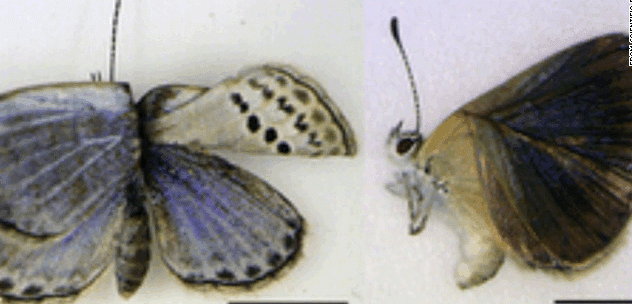
According to a research paper published in Scientific Reports, butterflies were chosen as a measure for environmental damage because their “wing colour patterns are sensitive to environmental changes,” and because in general, they are considered “useful environmental indicators.” During their study, scientists discovered a series of mutations in their butterfly sample, including “broken or wrinkled wings, changes in wing size, color pattern changes, and spots disappearing or increasing on the butterflies.”

Unfortunately, while 28% of the butterflies showed signs of mutation, a whopping 52% of their offspring featured similar physical abnormalities. These findings applied not only to the butterfly offspring bred in captivity, but also to a second sample pool collected in September, 5 months after the original samples were captured. The study concluded that “all of these results suggest that radiation caused adverse effects at the physiological and genetic levels.”

Although these findings suggests that the environmental damage in the wake of the Fukushima disaster could take a while to fully come to fruition, the scientists behind this study have assured the world that these butterfly mutations don’t have much bearing on humans: according to Joji Otaki, an associate professor at the University of the Ryukyus in Okinawa and one of the researchers, “humans are totally different from butterflies and they should be far more resistant” to radiation.

While the victims of the Fukushima disaster can thank their lucky stars that their offspring will likely be alright, the same cannot be said for the next generation of local wildlife, a sobering reminder of the often devastating costs of technological development.

(via CNN and Slate.)

Are you following The Mary Sue on Twitter, Facebook, Tumblr, Pinterest, & Google +?

TAGS: | | |


  • Life Lessons

    :( Makes me sad.

  • Anonymous

     This article is bunk.  The human toll will be staggering.  Over 1/3 of the children in Fukushima have thyroid tumors, some cancerous.  Many young people are having cardiac arrest as well.  This has been documented several times now by doctors and has been in the media.  The only difference between the effects seen on these butterflies and that of humans is that humans take longer to mature and reproduce!  Please get your facts straight!

  • http://twitter.com/ThunderBeetle Abby

    While it is terrible that those 1/3 of children are experiencing these problems, it does not mean that their problems can be passed down to the next generation. 

  • Anonymous

     You need to study up girl!  Learn something from the Chernobyl disaster.  There have been many studies showing the effects from radiation induced genetic mutations passed down through generations.  Thyroid disease, cancer and mutations will wreak havoc on people affected by nuclear disasters for generations.  Read this book: http://www.strahlentelex.de/Yablokov%20Chernobyl%20book.pdf

  • http://www.facebook.com/people/Christine-Dillon-Strickland/100001136719661 Christine Dillon Strickland

    Unfortunately, it is way too premature to determine that the people of Fukushima can “thank their lucky stars”. WAY too premature. And also most unfortunately, the fauna, flora and local insects and “wildlife” foreshadow exactly what effects will be seen in the HUMAN POPULATION. These mutated butterflies are an ALERT to us all. 

  • http://twitter.com/diefrankenmaus Kate

    The good news is that insects are very often used to determine environmental health in a way similar to canaries in coalmines. Because they are so much more sensitive, they can act as an early-warning system for humans. The bad news is that they ARE a warning. While humans are more radiation resistant, all it takes is one lucky cell (or–god forbid–genetic) mutation to create a major issue. 

  • Anonymous

    No Mothra reference?

  • http://www.facebook.com/marushka.france Marushka France

    butterflies are an indicator of widespread contamination and like the ‘canary in a coal mine’, an alarm that should be marshalling an appropriate response – evacuation, for one thing.  In no way should anyone listen to the likes of Joji Otaki.
    ALL species have profoundly similar, disastrous response to exposure to ionizing radiation.

    ** “Chernobyl: Consequences of the
    Catastrophe for People and the Environment”

    Alexey Yablokov, Vasily Nesterenko and
    Alexey Nesterenko

    Contributing Editor, Janette Sherman

    NY Academy of Sciences, Volume 1181,
    2009. 5,000
    Slavic language studies reviews, over 1,400 cited.

    http://www.strahlentelex.de/Yablokov%20Chernobyl%20book.pdf

    Yablokov authorized pdf; print
    orders@GrekoPrinting.com Call 734-453-0341 $12.50 in USA

  • http://www.facebook.com/marushka.france Marushka France

    Humans are not more ‘radio-resistant.’
    “Whole biological systems collapse; at the cell level, at the tissue level and
    at the population level. Burlakova and Nazarov describe these subtle effects at
    lower doses of internal irradiation in laboratory cell systems and also people,
    Grodzhinsky shows the effects in plants, – higher for internal exposures than
    external, Krysanov shows the effects in wild animals and Yablokov and the
    Nesterenkos in the children and adults living and continuing to live in the
    contaminated territories. The effects clearly operate at what are presently thought
    to be vanishingly low doses.”
    ECRR = European Committee on Radiation
    Risk
    Dr. Chris Busby, Scientific Secretary
    wrote Introduction.
    book, 2006, was co-edited with Dr.
    Alexey Yablokov
    “ECRR Chernobyl: 20 Years On”
    http://www.euradcom.org/publications/chernobylbook2009.htm

    the
    book!! http://life-upgrade.com/DATA/chernobylebook.pdf

    Spanish http://ciaramc.org/ciar/boletines/cr_bol226.htm

    http://www.euradcom.org/2010/uraniumreport.htm

  • http://www.facebook.com/marushka.france Marushka France

    in fact, genomic instability IS passed onto future generations and this study actually verifies it.  The two books I’ve reference in other comments would be invaluable to understanding,

  • Anonymous

    No, they aren’t. That’s not how radiation works. If you are there when the radiation is, you are damaged. If you are not there and you stay away until the radiation is at a safe level then you will not be damaged. Human left the area before the radiation got too high. Butterflies did not.

    EDIT: I am not saying everything is great. I’m sure the area is still suffering from widespread contamination and I am also sure that there was some human damage doen as well. But anyone who left the area before the radiation was dangerous would be fine, full stop.

  • JW

    Regardless of your opinion or even whether or not they are incorrect on something, it is NOT cool to dismissively call someone “girl” like that.

X