



Aurora Clark is Using Google PageRank to Predict Water Behavior at the Chemical Level
she blinded me with science
Google PageRank is the algorithmic process by which Google determines which websites are going to show up highest on a Google search for any given term, and while its actual details are a closely guarded secret (so as to keep people from gaming the system), it’s broad functions are well known. (It’s also named after a guy named Page, and not after its function.) Google PageRank keeps track of who links to who, and what words the hyperlinks are embedded into. If a page is getting a lot of incoming links for a given term, Google is more likely to show you that site, and that likelyhood is quantified as the site’s Google PageRank. When sites with a good Google PageRank link to other sites, their link-vote counts for more.
As the Atlantic says, it’s a system of ranking “based on mutuality and relevance,” and associate professor of chemistry Aurora Clark thought she might be able to use those same principles and computer programming tricks to predict how water molecules interact…. and she did.
Clark and her co-authors, Barbara Logan Mooney and L. Rene Corrales; have published a paper on their PageRank for chemistry, called moleculaRnetworks, which in the paper focuses on hydrogen bonds in water. Says Clark:
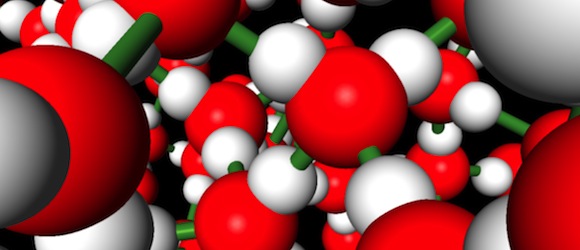
We take PageRank, and we say that two water molecules are like two Web pages, and that their hydrogen-bonding interaction is like a hyperlink. And then we map that onto millions and millions and millions of water molecules. And from that we get a picture of the entire water network… from that connectivity, and that network picture, we can actually predict chemical activity.
And predicting that chemical activity can have far reaching applications. It’s not just water that can be mapped using their program, if it could be expanded to allow other kinds of use chemical modeling it could save a lot of expense and danger in chemical reactions. The study of large molecular systems is no joke: scientists have been struggling to solve the problem of protein folding for years. Here’s Clark talking about her project in her own words:
(via Geekosystem.)
Have a tip we should know? [email protected]
Follow The Mary Sue:
