

comScore
  1. Mediaite
  2. Gossip Cop
  3. Geekosystem
  4. Styleite
  5. SportsGrid
  6. The Mary Sue
  7. The Jane Dough
  8. The Braiser

Inside of a dog it's too dark to read

Dep. of Justice May Take Apple and the 5 Biggest Publishers To Court Over Ebook Price Fixing


And we were just talking about Amazon throwing its weight around to get small publishers to lower their ebook pricing even if they think it would be financially against their interests… now the US Department of Justice has warned Apple, Simon and Schuster, Hachette Book Group, the Penguin Group, Macmillan, and HarperCollins that it will be investigating them for possible violations of Anti-Trust Law in their pricing of eBooks.

The case rests on the rules Apple set down for how publishers would be required to publish their books to the iPad, and some significant differences between their rules and the way publishers interact with physical retailers.

The way regular book sales work is that publishers sell copies to retailers for about half of what they recommend the cover price to be. Then retailers like Barnes & Noble set their own prices as they see fit. When Amazon.com launched its eBooks platform, it priced new bestsellers at a fixed $9.99, worrying many publishers. Would consumers become too accustomed to cheaper eBooks and expect real books to follow the trend? Would physical retailers be unable to keep up with the price drops, leaving Amazon as the eight-hundred-pound gorilla who could dictate the prices of the entire book market? They’d already seen something similar happen to music when iTunes started selling nearly every song at $0.99.

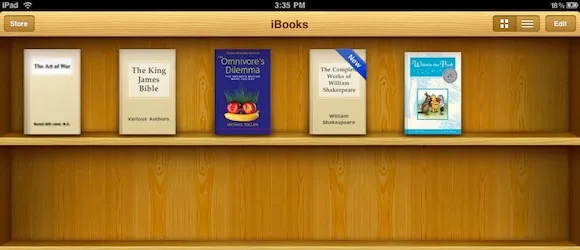
So when Apple debuted it’s tablet/eTeader and iBooks, it took a different approach. From the Wall Street Journal:

As Apple prepared to introduce its first iPad, the late Steve Jobs, then its chief executive, suggested moving to an “agency model,” under which the publishers would set the price of the book and Apple would take a 30% cut. Apple also stipulated that publishers couldn’t let rival retailers sell the same book at a lower price.

“We told the publishers, ‘We’ll go to the agency model, where you set the price, and we get our 30%, and yes, the customer pays a little more, but that’s what you want anyway,’” Mr. Jobs was quoted as saying by his biographer, Walter Isaacson.

The publishers were then able to impose the same model across the industry, Mr. Jobs told Mr. Isaacson. “They went to Amazon and said, ‘You’re going to sign an agency contract or we’re not going to give you the books,’ ” Mr. Jobs said.

The Justice Department believes these large publishers and Apple acted “in concert” to raise prices across the industry. Barnes & Noble’s chief executive William Lynch, who has already been deposed, has denied that any joint action was taken, and maintained that agency pricing has allowed smaller eBook publishers to thrive, and that getting rid of it would put the pricing power for the whole industry in a single company’s hands. Before agency pricing “Amazon often sold best-selling digital books for less than it paid for them, a marketing stance that some publishers worried would make the emerging digital-books marketplace less appealing for other potential retailers.”

This argument has apparently not been persuasive to the DoJ, who want to know how increasing prices under the agency model could have resulted in more competition. The model still restricts publishers who work with Apple from pricing books lower than their price on iOS devices, even for eReader retailers who take less than a 30% cut. The investigation is ongoing, so we’ll have to wait and see if litigation actually occurs. The DoJ has investigated eBook practices before, in 2009, and the European Union is also investigating under the same claims.

(The Wall Street Journal, via Ars Technica.)
TAGS: | | | | | | | |


  • http://www.facebook.com/profile.php?id=1208921 Nikki Lincoln

    I love that Amazon has cheap prices, but I find it interesting that this is being investigated and Amazon hasn’t been taken in for predatory pricing and monopolistic behavior. While the type of collusion that Apple is showing is also illegal, it is true that it’s fostering competition, but after that huge Microsoft trial a few years ago, I thought they were really cracking down on predatory behavior. Guess not.

    (sorry, really exciting to use that Economics degree….)

  • Francesca M

    I’m always so confused by ebook pricing. I mean I agree that author’s should be payed for their intellectual properties. But I don’t understand why a book and an ebook will be the same price. (Trust me you’ll see that a lot of places even amazon.) Based on that pricing it means I’m not paying for the paper that was used in my book but only for the writing itself. MY HEAD IT HURTS

  • Anonymous


    The way regular book sales work is that publishers sell copies to retailers for about half of what they recommend the cover price to be. Then retailers like Barnes & Noble set their own prices as they see fit. ”

    This is FLAT OUT WRONG. Booksellers do not and are not allowed to “set the price”  . The publishers usually sell booksellers copies at 40-50 percent discounts and then the bookseller is responsible for selling the books at cover price. They then have the option of DISCOUNTING the books in store.

    The problem with this, however, is that when you’re buying a book at 40%, and you discount something to 30% (which is what most hardcover bestsellers are sold at in most corporate stores, and therefore smaller independent stores have to do so as well in order to keep in competition), you’re only making 10% off the book. That is BARELY enough to stay in business and cover the expenses of actually purchasing the products. 

    In no world do booksellers ever “set the price” or get to decide that they will mark up prices. The profit margin of books is very small, and it is very frustrating for booksellers to continually reassure customers that the prices of books are so high because the publishers set the price and that booksellers have no control over it, and that the only reason you see books cheaper on Amazon is because they game the system by not charging sales tax and they are so huge that they have the money to blow on discounting the hell out of their books.

    There is so much misinformation out there about how the book industry works and how bookstores function, so please do your research before you continue to propagate damaging and harmful misrepresentations.

    Love, 

    A manager at a new independent bookstore who would like to keep my job, please. 

  • http://twitter.com/arkhetypon Kate

    I agree. I’m often very frustrated by the pricing for eBooks. eBooks don’t have to be printed, be shipped, be unpacked, be shelved, and be sold by a bookseller in a physical location. Those are ALL things that go into the pricing of a hard-copy book. eBooks don’t have any of those costs. 

    Additionally, when I buy a hard-copy book, I own it. I can mark it, lend it to someone else, sell it, set fire to it, use it to prop up my computer, take out pages and make funny hats, and–oh–read it without need for a battery. I can’t do ANY of those things with most eBooks (yes, some of them allow for lending, but by no means all). I’m paying for the “privilege” of being allowed to access a file on one very specific device or platform. I don’t OWN that book, I’m just “leasing” it. If tomorrow the bookseller decided they were taking down their service, I would lose EVERY book I’d purchased (in most cases). 

    Publishers should take a page from the folks at Baen. Not only do they have a FREE eBook library (often the first in a series to whet your appetite), but they price their eBooks very reasonably and when you purchase the book you OWN the file. It’s downloaded to your computer and you can do whatever the hell you want with it. Yes, it may allow for more piracy, but Baen has seen excellent returns with this model, so it seems that the benefits far outweigh the costs. 

  • Anonymous

    dear department of justice,

    while you’re at it, could you tell these publishers (im looking at you, harpercollins) to quit screwing libraries when they try to buy ebooks and licensing?  i concede that sometimes you have to replace a physical book because of time, wear, and tear, but 17 circulations is lowballing it hardcore.  so quit being dicks pleaseandthankyou.

    cordially,

    pissed off librarians everywhere

  • Anonymous

     this ^

  • http://pulse.yahoo.com/_R7GVNIKWG3S2UTHEQOMSZXT4M4 Anna B

    Okay, here’s the thing. I happen to work in one of these 5 big publishers and the problem, admittedly, with pricing books is that people in general have a vague idea of how the pricing is decided. Consumers appear to think that we take the cost of creating the book (ink and paper) + publisher profit, and that’s it. It’s a lot more complex, as you probably already figured, but because of this generalization, people think ebooks don’t cost anything because it isn’t printed on paper. The “machine” behind distributing and selling ebooks can be just as expensive as printing a book. We pay the cost of storing this digital data up to the minute someone takes it in their ereaders.We pay premiums to make sure that each ebook is protected from piracy (obviously, some hackers will still get it, but at the very least, it isn’t a free-for-all). We have people behind the scenes converting book files into ebook files, formatting, selling, maintaining, updating the technology, and so on and so forth. It’s a complicated process, that’s why we have an entirely separate digital department. It isn’t lumped within each imprint/publisher, there’s a full staff, executives, and managers making sure that the digital books of the business are well taken cared of. And people also forget that it’s not necessarily a case of Book Readers + the Hoard of eReader Reading People Who Have Never Picked Up a Book Before In Their Lives Until eReaders Came to Being.  A great percentage of eReading Consumers used to only buy physical books. 

    So all in all, the ebooks do help in covering the cost of everything that goes into making a book. 

    Hope that kinda helps?

  • Michail Velichansky

    The usual claim is that the price of paper, shipping etc. is pennies, because all of it is done in such bulk. So the price of all the physical-copy stuff for a single book is almost nothing. You really are just paying for the writing, the editing, proofreading, marketing, and the ability for the publisher to acquire more books that hopefully you enjoy.

    I do agree all the DRM etc. is super lame, though.

  • Michail Velichansky

    Wasn’t that just HarperCollins? Or have other publishers also follow suit? Because yeah, that’s super lame.

  • http://twitter.com/eBookPriceDrops eBook Price Drops

    Great post Susana,

    There seem to be more and more books showing up discounted.. We built an ebook price drop monitor this past weekend at a hackathon. It’s especially full of discount books right now for Kindle. The upside is right now there is a steady flow of new books that are a bargain to the end customer. Ideally Amazon will find the right balance so everyone wins. Here’s our site for any price-smart book lovers out there.

    eBookPriceDrops.com 

    Thanks again for covering this important subject Susana.

  • Anonymous

    yeah, i *think* its just harpercollins, but i recently read that penguin has stopped offering library ebooks.  they have ended their relationship with overdrive–a popular digital distributor which works with public libraries.  kindle library lending is also cut off. 

    these trends are setting bad precedents for the publisher/library relationship.  in a time when publishers are losing money and libraries are losing funding, we should be looking for opportunities to collaborate with each other and move our organizations forward in the changing technological environment.

  • http://www.facebook.com/profile.php?id=1208921 Nikki Lincoln

    I’m going to go home and make funny hats out of all my books now. 

  • http://www.facebook.com/profile.php?id=1232957605 Leah Nardo

    If you take production costs into account, it is ridiculous that publisher-set ebook prices are anywhere near the same as real books.  You pay a small fortune for a hardcover book because it is hardcover.  When the paperback comes out, it is cheaper because it costs less to make it.  All books are already priced according to their format.  Shouldn’t ebooks be the same?  Paying $25 for a ebook because the hardcover is comparable is absurd.  Not to mention, much like music files, when you buy an ebook, you technically don’t even own it.  You’re just buying a license to it, much like with software, that can be revoked at any time according to the agreement that you checked the box for when you registered the ereading product.

    I’m not against the author or even the publishing house getting their fair share, but when it comes to ebooks, it feels like a scam.

  • http://pulse.yahoo.com/_R7GVNIKWG3S2UTHEQOMSZXT4M4 Anna B

    See my response to that above.

  • badger3k

    Destroy thousands of lives through banking fraud…no worries.  Rig the stock market…all good.  Torture people and hold them indefinitely without any charges…nothing to see.  Fix ebook prices – justice department to the rescue!

  • Francesca M

    Thank you for taking the time to explain. I really appreciate it.

  • Ellen Scott

    Hooray for independent bookstores! I wish you success!

  • http://pulse.yahoo.com/_R7GVNIKWG3S2UTHEQOMSZXT4M4 Anna B

    Additionally, when publishers acquire an author and her work, we hardly ever look to make a profit within the first year of publication. It’s obviously great if it pays off within the year of publication, but during the acquisition meeting, spreadsheets with estimates of up to ten years are often pulled up to see if, when, and how much profits will be seen from that book. And THEN, there’s a different spreadsheet computation that figures in the rising ebook sales. Always, the insertion of ebook sales estimates amounts to less profit. I mean, yeah, boohoo for the big publishers, but they’ve got hundreds of employees that they have to pay before that book even gets on the bookstore shelves.

    The spreadsheets are obviously not prophetic texts. They are estimates based on consumer patters in the past, so it’s happened that a book we thought would sell becomes a complete failure.

    So no, publishers do not sit at their desks, giggling and rubbing their hands together and dreaming of all the enormous profit we would be getting by selling more ebooks versus hardcover, even if Amazon never lowers ebook prices.

X